Plato’s Allegory of the Cave: Learning to See Beyond the Shadows

More than two thousand years ago, the Greek philosopher Plato offered an allegory that remains surprisingly relevant to modern life. It was not really a story about caves, prisoners, or shadows. It was a story about perception, education, awareness, and the difficulty of questioning what we have always believed to be true. In many ways, Plato’s Allegory of the Cave is also a story about the human journey from simply accepting what we have been shown toward developing the ability to investigate, question, experience, and think for ourselves.

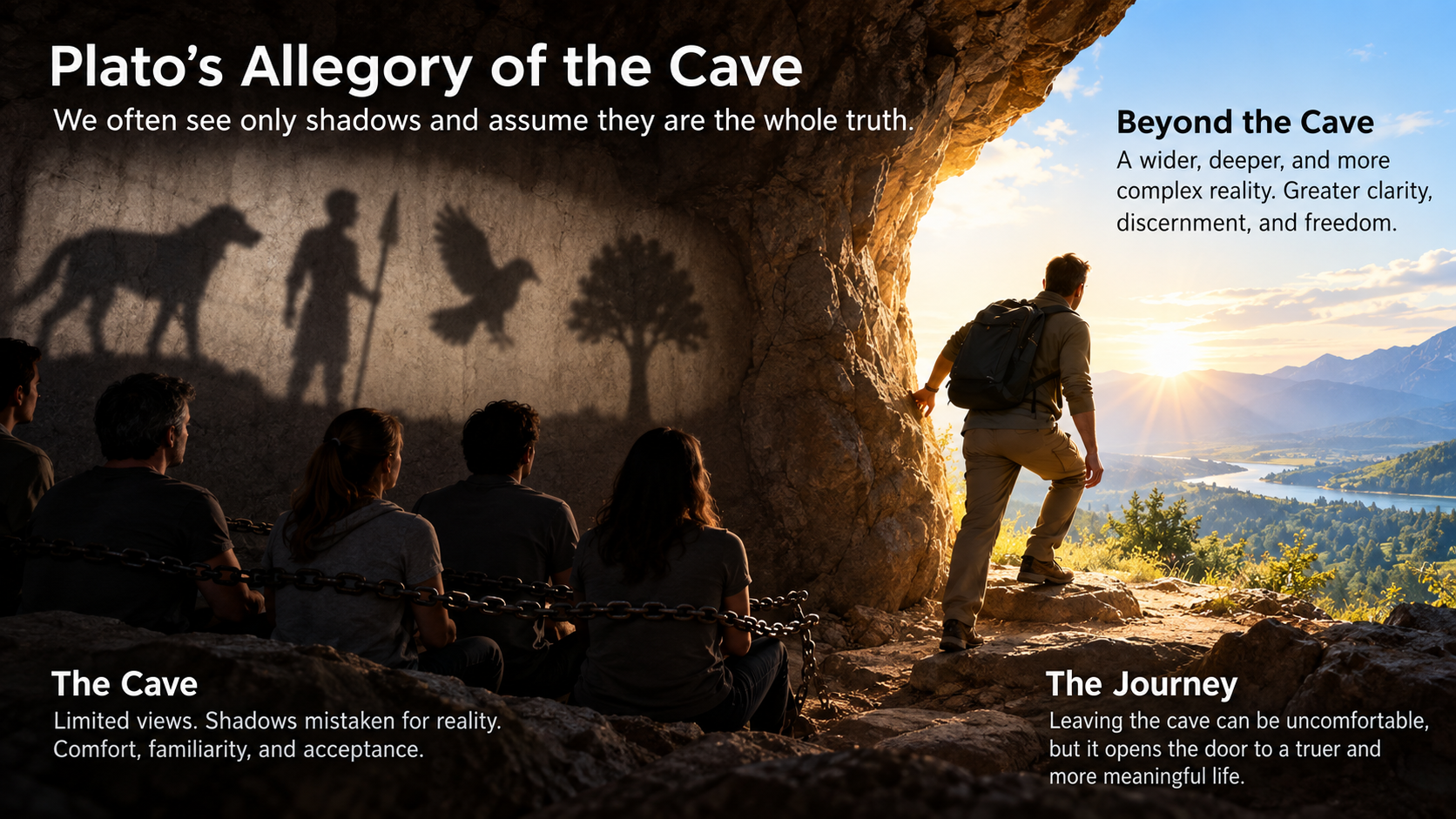
The allegory appears in Book VII of Plato’s Republic, written around 375 BCE. Plato asks us to imagine people who have lived their entire lives imprisoned inside an underground cave. They are chained in such a way that they can look only toward a wall in front of them. Behind them burns a fire, and between the prisoners and the fire other people carry various objects. The fire projects shadows of those objects onto the wall. Because the prisoners have never known anything else, they naturally assume that the shadows are reality.

This is the part of the allegory that has always fascinated me. The prisoners are not necessarily stupid, gullible, or intentionally ignorant. From their perspective, they have evidence for what they believe. Everyone around them sees the same shadows, and the shadows have always been there. Why would they question something that appears so obvious?

Plato then asks us to imagine that one prisoner is released. At first, freedom is not particularly pleasant. When the prisoner turns toward the fire, the light hurts his eyes. Objects that created the familiar shadows appear strange and confusing. If he is eventually brought outside the cave into daylight, the experience becomes even more uncomfortable. Gradually, however, his eyes adjust. He begins to recognize reflections, physical objects, the surrounding world, and eventually the sun itself.

For Plato, this movement represented the journey from ignorance toward knowledge and philosophical understanding. Education was therefore much more than placing information into someone’s mind. Plato described it as a kind of turning of the soul, redirecting attention from appearances toward deeper understanding (Plato, trans. 1992). Modern philosophical interpretations similarly describe the cave as an illustration of the movement from imagination and belief toward reason and understanding (Internet Encyclopedia of Philosophy, n.d.).

Yet there is another part of the story that may be even more important. The freed prisoner eventually returns to the cave and attempts to explain what he has discovered. Instead of immediately welcoming his new knowledge, the other prisoners resist him. His eyes, now accustomed to daylight, initially have difficulty seeing in the darkness. To those who remained behind, this may appear to prove that leaving the cave harmed him rather than enlightened him. Plato even suggests that they might violently resist someone attempting to free them. That observation about human behavior remains remarkably recognizable.

The Caves We Build Around Ourselves

Most of us would probably like to imagine that we would be the person who walks out of Plato’s cave. Yet it may be worth considering how often we are prisoners as well. I suspect that throughout a lifetime we occupy both positions.

Our caves may be constructed from culture, family, education, religion, politics, professional training, social groups, advertising, social media, and personal experience. None of these influences are automatically harmful. Many provide valuable knowledge, structure, identity, and community. The problem begins when we stop recognizing how strongly they influence what we see.

Modern psychology provides an interesting parallel. Human perception is not simply a camera recording objective reality. Previous beliefs, expectations, attention, and experience can influence what we notice and how we interpret it (Weir, 2026). Research concerning misinformation likewise suggests that people can be less critical of information that fits comfortably within an existing worldview, while repetition and social reinforcement can make questionable information seem increasingly believable (American Psychological Association [APA], 2024).

Plato obviously knew nothing about cognitive psychology, television, smartphones, or social media, but his shadows provide a remarkably useful metaphor for them. Information now reaches us through an enormous variety of sources, including teachers, organizations, charismatic personalities, political movements, advertisements, wellness trends, and online algorithms. The lesson should not be that all these sources are deceptive. The more useful lesson is that information deserves examination rather than automatic acceptance. This applies equally to traditional wisdom and modern knowledge.

I have spent much of my life studying martial arts, holistic health, Eastern philosophy, traditional practices, and modern approaches to wellness. One lesson that becomes increasingly apparent with experience is that age does not automatically make something true, just as novelty does not automatically make something better. An ancient practice deserves investigation rather than blind reverence, while a modern scientific claim deserves understanding rather than blind acceptance. A respected teacher may possess tremendous knowledge while still being mistaken about some things. The goal is not cynicism. It is discernment.

Leaving One Cave Does Not Mean We Have Arrived

Plato’s allegory also relates closely to the idea of enlightenment, although perhaps not in the way the word is commonly used today. Enlightenment is sometimes presented as though a person reaches a particular level of consciousness and thereafter possesses some permanent superior understanding. I have never found that interpretation especially convincing.

There are moments when something suddenly becomes clear that we previously could not understand. It can feel almost as if someone turned on a light in a dark room. We recognize a pattern in our behavior, understand something a teacher tried to explain years earlier, see a relationship differently, or reconsider an old belief. These might be considered small moments of leaving the cave.

But walking out of one cave does not guarantee that we are no longer standing in another.

The person who recognizes that one teacher was wrong can become equally devoted to another. Someone who escapes one rigid ideology can adopt another. A person disappointed by conventional medicine might become overly trusting of alternative or traditional medicine, just as someone who recognizes unsupported alternative claims might become unnecessarily dismissive of useful allopathic practices.

This is one reason awareness is better understood as an ongoing practice rather than a final destination. It also fits surprisingly well with the Taoist principle of wu wei. Wu wei is often translated too simplistically as “doing nothing.” A more practical interpretation involves sensitivity to circumstances and responding appropriately without unnecessary force. To do that well requires the ability to perceive circumstances without allowing assumptions, fear, habit, or ego to completely dictate our response.

Teachers Should Help Us Turn Around

The allegory also raises an important question about the role of teachers.

Plato rejected the idea that education amounts to inserting knowledge into someone who does not possess it. Instead, education helps turn the learner toward something he or she may not previously have been able to see (Plato, trans. 1992).

That comes very close to my own understanding of teaching and even healing.

A good teacher can provide information, demonstrate techniques, offer perspectives, ask questions, correct mistakes, and point toward possibilities. But the student still has to look. The student must practice, experience, investigate, compare, and eventually make the knowledge his or her own.

The same applies to health. A physician, therapist, coach, instructor, or healer can provide valuable assistance, but ultimately we continue to live inside our own bodies. Someone can explain nutrition, but cannot eat well for us. Someone can teach movement but cannot exercise for us. Someone can demonstrate breathing practices but cannot breathe for us.

This also places a responsibility on teachers. Once people begin listening to us, it becomes easy to mistake influence for truth. A teacher who genuinely wants students to grow should encourage greater independence rather than greater dependence. If students are never permitted to question the teacher, explore other perspectives, or eventually disagree, education can quietly become another set of chains.

The Discomfort of Changing Our Minds

One of the most realistic elements of Plato’s story is that leaving the cave hurts.

We often imagine learning as an accumulation of knowledge. Sometimes it is. But some of the most important learning requires letting go of something we previously believed. Changing a long-held belief may require admitting that we misunderstood something, trusted the wrong person, followed an ineffective practice, participated in something we now view differently, or taught information that we later came to question. The greater our personal investment in a belief, the more difficult reconsideration can become. Modern psychological research supports the idea that identity and existing worldviews can strongly influence how people evaluate information and misinformation (APA, 2024).

There is no shame in having once believed something based upon the information and experience available to us at the time. The more important question is what we do when better information becomes available.

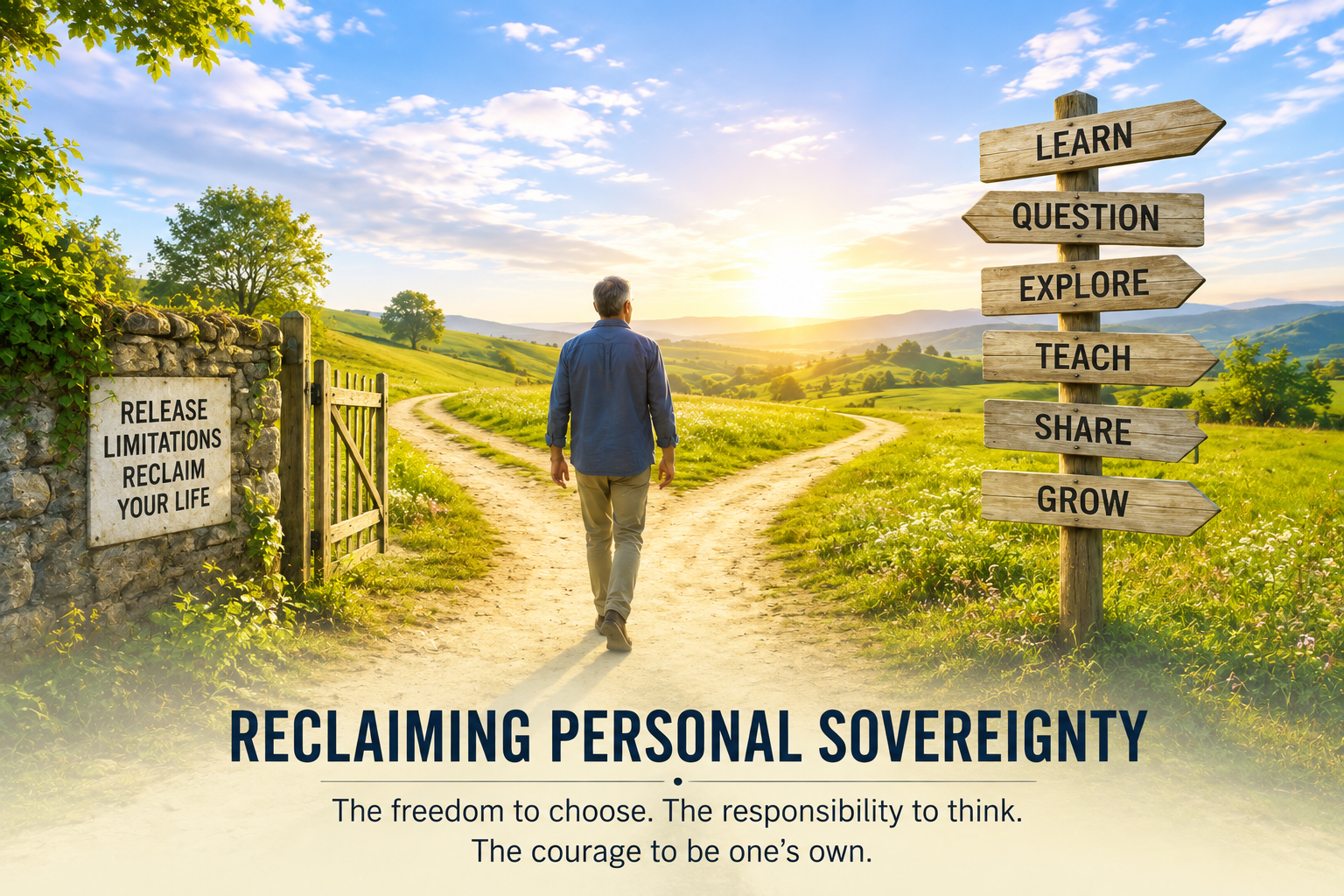
This is where personal sovereignty becomes important. Sovereignty does not mean refusing teachers, rejecting authority, or assuming that our personal opinion is always correct. That would merely replace external authority with unchecked ego. It means accepting responsibility for examining what we believe and remaining willing to modify those beliefs as experience and evidence accumulate.

We can therefore respect tradition without becoming imprisoned by it, value scientific knowledge while recognizing that scientific understanding evolves, and participate in communities without allowing belonging to replace independent thought.
Returning to the Cave

There is one final part of Plato’s allegory that deserves consideration, particularly for anyone who teaches, writes, mentors, or shares knowledge. The journey does not end when the prisoner reaches the sunlight. He returns.

For Plato, this had political implications. The philosopher who develops greater understanding has a responsibility to return to society rather than simply remaining apart from it (Internet Encyclopedia of Philosophy, n.d.). I believe there is a broader lesson here as well. Knowledge becomes more meaningful when it can be used to help others see possibilities they might not have considered.

As we accumulate experience, education, mistakes, injuries, successes, disappointments, and occasional moments of clarity, we have opportunities to share what we have learned. That does not require demanding that others accept our conclusions. Plato’s story itself warns us that people may resist perspectives that challenge the world they know. Sometimes our responsibility is simply to offer another direction in which to look.

This is one reason I continue to teach, write, study, and share what I have learned. After decades of martial arts, wellness practices, philosophy, teaching, and life experience, I certainly do not believe that I have finally escaped every cave. If anything, experience has made me more aware of how many caves there may be.

Perhaps that is one of the most valuable lessons contained in Plato’s allegory. Wisdom does not necessarily mean reaching a place where we finally possess all the answers. It may have more to do with developing the curiosity to investigate what we believe, the courage to change when necessary, and the humility to recognize that what appears obvious from where we are standing may still be only a shadow.

References

American Psychological Association. (2024, March 1). What psychological factors make people susceptible to believe and act on misinformation? https://www.apa.org/topics/journalism-facts/misinformation-belief-action

Internet Encyclopedia of Philosophy. (n.d.). Plato: The Republic. https://iep.utm.edu/republic/

Plato. (1992). Republic (G. M. A. Grube, Trans.; C. D. C. Reeve, Rev.). Hackett Publishing Company. (Original work published ca. 375 BCE)

Weir, K. (2026, July 1). Is seeing believing? How we make sense of the world around us. Monitor on Psychology, 57(5). American Psychological Association. https://www.apa.org/monitor/2026/07-08/sensory-processing-systems

Chiron: The Wounded Healer and the Responsibility to Heal Ourselves

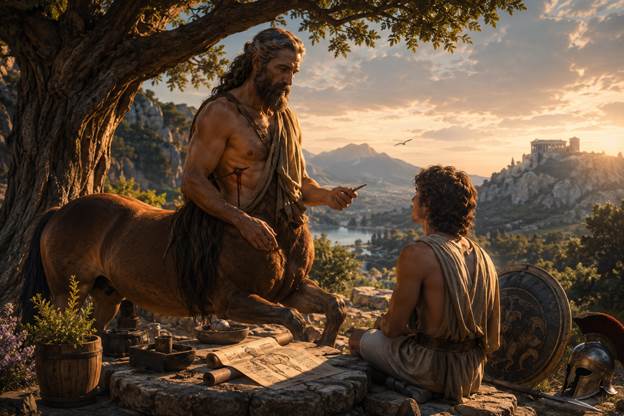
One of the more interesting figures from Greek mythology is Chiron, the centaur who eventually became associated with what we now often call the wounded healer. His story has survived for thousands of years, perhaps because it touches upon something that remains very human today. Sometimes the people who are best able to help others are not those who have avoided pain, injury, disappointment, or hardship. They are the people who have experienced these things, struggled with them, learned from them, and eventually found a way to turn their experiences into something useful. This idea has always resonated with my own understanding of holistic health.

I have never been particularly comfortable with the idea that a healer is someone who simply “heals” another person. Certainly, physicians, therapists, teachers, herbalists, bodyworkers, coaches, and other practitioners can provide valuable assistance. But ultimately, much of the healing process still takes place within the individual. Someone can show us the path, provide information, offer treatment, teach exercises, recommend changes, or help us understand what may be happening. But at some point, we still have to participate in our own healing.

The story of Chiron provides an ancient metaphor for this idea.

Chiron Was Different

In Greek mythology, centaurs were generally portrayed as wild and unruly creatures, part human and part horse, often representing the tension between our more rational nature and our instinctive or animal nature. Chiron was different. He was known for wisdom, medicine, music, hunting, ethics, and teaching. More importantly, Chiron became the teacher of heroes.

Among those associated with his instruction were Achilles, Asclepius, Jason, and other important figures of Greek mythology. Chiron was therefore not simply a warrior or healer. He was a mentor. His value was found largely in what he was able to awaken, develop, and cultivate in others. That distinction is important.

The greatest teacher does not necessarily create followers who remain dependent upon the teacher. A good teacher gradually makes the student more capable of standing on his or her own. In martial arts, holistic health, tai chi, qigong, fitness, meditation, or virtually any other discipline, the purpose of instruction should eventually be to increase the student’s own awareness and ability.

I can teach someone how to breathe differently, move more efficiently, improve balance, strengthen the body, manage stress, or become more aware of unhealthy habits. But I cannot breathe for that person. I cannot exercise, sleep, or make better food choices for them. And I certainly cannot practice tai chi or qigong on their behalf. At some point, knowledge has to become personal responsibility.

The Wound That Could Not Be Healed

Chiron’s story becomes particularly meaningful because the great healer himself eventually suffered from a wound that he could not heal. According to the myth, Chiron was accidentally wounded by one of Heracles’ arrows, which had been poisoned with the venom of the Hydra. Because Chiron was immortal, the wound created a terrible paradox. He possessed tremendous knowledge of healing, yet he could not completely heal himself. He could neither fully recover nor simply die from the injury. This is where Chiron becomes much more interesting as a symbol.

We often think of health in very absolute terms. Something is either healthy or unhealthy. Something is either healed or injured. A treatment either works or does not work. Yet real life is rarely that simple. Most people who live long enough accumulate a few wounds.

Some are physical. Others are emotional. Some involve relationships, careers, financial setbacks, betrayals, disappointments, failures, or simply the consequences of our own poor decisions. Aging itself gradually teaches us that the human body is not an indestructible machine.

The question then becomes not whether we can avoid every wound, but what we do with the wounds we acquire.

Healing Does Not Always Mean Erasing the Wound

This may be one of the most useful lessons we can draw from Chiron. Modern culture sometimes presents healing as though the goal is to completely erase whatever happened. We want the pain gone, the injury repaired, the stress eliminated, and the unpleasant experience forgotten. Sometimes that is possible. Sometimes it is not.

There are injuries that leave limitations. Experiences that permanently change our perspective. Losses that cannot be reversed. Bodies that change with age. Relationships that cannot be restored. Decisions whose consequences cannot simply be undone. But something can remain imperfect without becoming useless.

A person can carry a wound and still become stronger, wiser, more compassionate, and more capable. In fact, sometimes the wound becomes part of the education. This does not mean that suffering is automatically beneficial. Pain by itself does not necessarily produce wisdom. A person can experience hardship and learn very little from it. The important factor is what we eventually do with the experience.

Do we become bitter, helpless, and permanently defined by what happened? Or do we study it? Do we learn or do we adapt? And perhaps eventually, do we use what we have learned to help someone else? That is where the wounded healer becomes meaningful.

From Patient to Participant

One of the problems I see in our modern approach to health is the temptation to become passive participants in our own well-being. We develop a problem and naturally want someone else to fix it. Sometimes professional intervention is absolutely necessary. There are times when we need physicians, surgeons, medications, physical therapists, counselors, or other trained professionals. Self-responsibility should never be confused with refusing appropriate care. But professional care and personal responsibility are not opposites. They should work together.

If someone has high blood pressure, chronic stress, poor mobility, weak muscles, inadequate sleep, or unhealthy eating habits, there may be medical treatments that help. But there are also questions that belong to the individual.

What am I eating? How much am I moving? Am I sleeping well? How am I breathing? Do I respond well to stress? What habits have I developed? What am I willing to change?

Those questions bring us back to holistic health because holistic health is not simply about collecting alternative therapies. It is about recognizing that many different aspects of our lives influence one another.

The body affects the mind. The mind affects the body. Our environment affects both. Relationships, physical movement, nutrition and sleep habits all matter. Purpose and Community have effects upon us. Stress affects us too. And our daily decisions accumulate over time. None of this guarantees perfect health. Chiron himself reminds us of that.

We can do many things correctly and still become injured, sick, or eventually grow old. Self-responsibility is not the promise of immortality. It is simply the recognition that we should participate as fully as possible in the life and body we have been given.

The Healer as a Teacher

Perhaps this is why I prefer to think of the healer primarily as a teacher. A teacher does not claim ownership over another person’s healing. A teacher provides tools.

This is very similar to martial arts instruction. A teacher can demonstrate a technique hundreds of times, but eventually the student must practice it. The teacher can explain posture, alignment, timing, relaxation, breathing, and awareness. But understanding does not enter the student’s body simply because the instructor understands it.

Practice creates understanding. The same principle applies to health. Someone may explain meditation, but we still have to sit quietly. Another may explain nutrition, but we still have to choose what goes onto the plate. And still, someone else may explain exercise, but we still have to move. A teacher may teach us methods for managing stress, but eventually we have to recognize our own patterns and apply those methods when life becomes difficult. The teacher provides the map. The student still has to walk.

Chiron’s importance was therefore not simply that he possessed knowledge. It was that he passed knowledge forward.

Turning Experience Into Wisdom

As we get older, we accumulate something that younger people simply cannot acquire quickly: experience. But experience and wisdom are not necessarily the same thing.

Experience is what happens to us. Wisdom develops when we reflect upon what happened, extract something useful from it, and apply that understanding more intelligently in the future. That process can occur throughout an entire lifetime.

The injuries we recover from may teach us something about movement. Periods of stress may teach us about our nervous system. Mistakes may teach us humility. Poor decisions may improve our judgment. Difficult relationships may teach us boundaries. Aging may teach us that strength is valuable, but adaptability may be even more important.

Even our limitations can become teachers. In that sense, each of us carries a little bit of Chiron. We are all wounded in some way eventually. Hopefully, we all discover things that we cannot completely control. And we all encounter limitations. And ultimately, none of us gets out of this life alive. But that does not make our efforts meaningless. Quite the opposite. It makes what we do with the time, health, knowledge, and experience available to us even more important.

Becoming Our Own Wounded Healer

Perhaps the lasting value of Chiron is not that we should search for some extraordinary healer who possesses secret knowledge. It may suggest almost the opposite. We can seek knowledgeable teachers and accept help when it is needed while still recognizing our own responsibility within the process. Through study, practice, mistakes, adjustments, and greater attention to what our bodies and minds are telling us, experience gradually becomes understanding. A good teacher can help guide that process, but ultimately, we are the ones who must put the lessons into practice and determine how they fit into our own lives. And eventually, if we are fortunate, some of what we learn becomes useful to others.

The wound does not have to become our identity. Neither does it have to disappear before we can move forward. Sometimes it simply becomes part of the story.

Chiron could teach healing while carrying a wound of his own. There is something profoundly human in that image. We do not have to achieve perfect health before encouraging someone else to take better care of themselves. We do not have to have lived a perfect life before sharing something we have learned. And we do not have to possess all the answers before becoming useful to another person.

Perhaps the responsibility is simply to continue learning from our experiences and to use what we learn wisely. That, to me, is one of the most practical meanings behind the ancient story of the wounded healer.

We may not be able to heal every wound. But we can decide what the wound teaches us. And sometimes, what we learn while healing ourselves becomes exactly what allows us to help someone else.

When One Drop Changes the Water

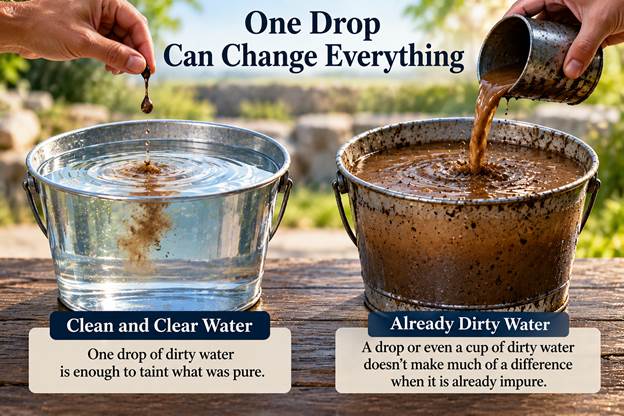
Many decades ago, I was introduced to a simple analogy that has stayed with me. Imagine two buckets of water. One contains water that is clean, clear and pure. The other contains water that is already cloudy and contaminated. Now place a drop of dirty water into each bucket.

In the bucket of clean water, that single drop represents contamination. Perhaps it is barely visible. Perhaps no one looking at the bucket would even notice it. Nevertheless, something has changed. What was previously pure is no longer completely pure.

Put that same drop into the bucket of dirty water and almost nothing appears to happen. Add another drop, and there is still little noticeable difference. You might even pour an entire cup of dirty water into it without substantially changing its appearance. The water was already contaminated.

When I first learned this analogy, it was being used to describe people, character and behavior. I have thought about it many times since then because I believe there is considerably more depth to the lesson than may initially appear.

A person who has spent years trying to live honestly may be deeply troubled by a single act that violates his or her values. A lie that seems insignificant to someone else may weigh heavily upon that individual. A questionable decision, betrayal of trust or deliberate act of dishonesty may produce considerable discomfort. From the outside, another person might wonder why such a seemingly small event matters so much.

But the issue is not necessarily the size of the drop. It is the condition of the water into which it fell. When we have established standards for ourselves, violations of those standards become noticeable. There is contrast. Something feels different because we have crossed a boundary that previously meant something to us.

This does not mean that a fundamentally honest person becomes dishonest because of one mistake. Human beings are imperfect, and all of us occasionally make poor decisions, lose our patience, act selfishly or fail to live up to our own expectations. I do not believe purity should be confused with perfection. In fact, demanding moral perfection can itself become unhealthy.

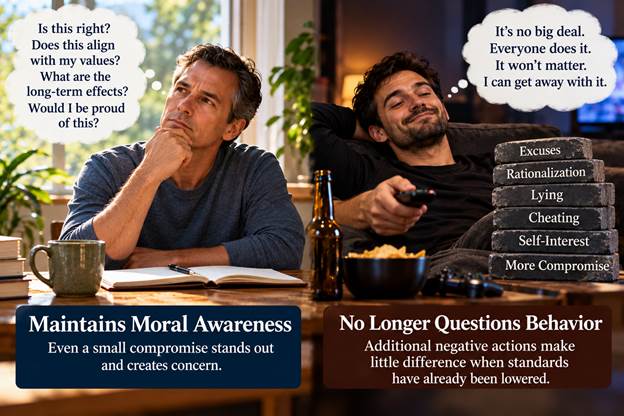
The more important question is what happens next. Do we recognize what we did? Do we experience enough discomfort to examine it? Do we apologize when appropriate, make restitution when possible and learn from the experience? Or do we begin explaining to ourselves why the behavior really wasn’t that bad?

That distinction matters. The first drop may not fundamentally change our character, but it can change what we are willing to tolerate. Once we have crossed a boundary, crossing it again can become easier. We have already created the explanation. We have already survived the discomfort. We have already demonstrated to ourselves that the rule can be bent. The second drop may therefore be easier than the first.

This is where the analogy becomes particularly meaningful to me. Much of what eventually becomes destructive behavior probably does not begin with a conscious decision to become dishonest, unethical or harmful. It begins with small compromises that are individually easy to justify.

“It’s only this once.”

“No one will know.”

“Everybody does it.”

“It really doesn’t hurt anyone.”

“I deserve this.”

“I didn’t have a choice.”

Any one of these explanations may even contain some truth. But repeated often enough, rationalization can gradually change our standards. The question slowly moves from “Is this right?” to “Can I get away with this?” or “Is this really bad enough to matter?” Those are very different questions.

There is also a psychological element involved. Human beings have a remarkable ability to adapt to their surroundings and experiences. This capacity is essential to survival, but adaptation is not always beneficial. We can become accustomed to things that once disturbed us.

The first exposure to dishonest behavior may create considerable discomfort. Repeated exposure can make it seem less unusual. Eventually it may become ordinary. What once generated an internal warning no longer produces much reaction. In that sense, the cloudy water represents more than wrongdoing. It can represent normalization.

This may help explain why two people can encounter the same questionable situation and respond very differently. One person may immediately feel that something is wrong and want no part of it. Another may barely notice. Their reactions may reflect different experiences, environments, values and boundaries.

If someone has lived or worked for years in an environment where deception, manipulation, hostility or unethical behavior is routine, another example may simply blend into the background. The additional drop does not create much contrast.

For someone who has not normalized those behaviors, however, the same event may stand out sharply. This is why I think we should be cautious about judging another person’s sensitivity too quickly. Someone who refuses to participate in what appears to be a minor ethical compromise may not be naive, rigid or overly sensitive. That individual may simply recognize the significance of the first drop.

At the same time, this analogy should never be used to permanently label people as clean or dirty. Human beings are not buckets of water, and character is not a substance that becomes permanently contaminated. People learn, change, mature, make amends and rebuild themselves. Someone who has lived destructively for years is not condemned to remain that way.

The metaphor works best when we apply it to patterns and standards rather than permanent identities.

There is another side to the analogy that I find equally important. If dirty water can represent accumulated compromise, then perhaps clarity can represent conscious cultivation. We cannot necessarily remove every mistake we have made, but we can become increasingly aware of what we allow into our lives. We can examine our habits, relationships, environments and decisions. We can recognize when something is gradually pulling us away from the person we intend to be. This requires self-reflection.

It is much easier to recognize contamination in someone else’s bucket than in our own. We readily notice another person’s dishonesty, hypocrisy, selfishness or poor judgment while finding sophisticated explanations for our own behavior. Genuine self-development requires periodically looking into our own water.

What have I begun accepting that once bothered me?

What have I started rationalizing?

Have I lowered a standard simply because maintaining it became inconvenient?

Have repeated exposure and familiarity caused me to mistake something common for something acceptable?

These are uncomfortable questions, but discomfort can serve a purpose. Just as pain can alert the body that something requires attention, moral or emotional discomfort can tell us that our actions are moving away from our values.

I have increasingly come to believe that character is built through these seemingly small decisions. We tend to imagine integrity being tested during great moments of crisis, but most of the time it is probably shaped through ordinary choices that no one else sees. One drop at a time.

That is also why protecting one’s standards should not be confused with believing oneself morally superior to others. The lesson is not that I possess clean water while everyone else is contaminated. The lesson is that I am responsible for paying attention to what I allow into my own bucket.

We cannot control every circumstance that touches our lives. We will make mistakes. We will sometimes disappoint ourselves and others. We will occasionally discover that something we believed or practiced was misguided. None of this requires us to abandon our standards. Instead, awareness gives us the opportunity to correct our direction.

The old bucket analogy has stayed with me because of its simplicity. It reminds me that substantial changes in character do not always arrive as dramatic events. Sometimes they begin almost invisibly. A small compromise becomes easier to repeat. Repetition becomes familiarity. Familiarity becomes acceptance, and acceptance can eventually become part of our character.

The important question, then, may not simply be whether one drop of dirty water can ruin an entire bucket. Perhaps the more useful question is whether we still notice when the drop falls.

As long as we notice, reflect and care enough to respond, we have retained something extremely valuable: the ability to recognize the difference between the person we are becoming and the person we intend to be.

What is the Point? We are all going to die anyway.

Over the years, some of the wiser mentors I have known have shared a simple idea with me that has remained in the back of my mind: we should strive to earn the life we live.

I do not interpret this as meaning that we somehow have to earn the right to exist, nor do I believe our worth should be measured by how much money we make, how productive we are, or how many accomplishments we can accumulate. I understand it more as an invitation to participate fully in the life we have been given. If we are fortunate enough to wake up to another day, perhaps there is something to be said for trying to make reasonable use of it.

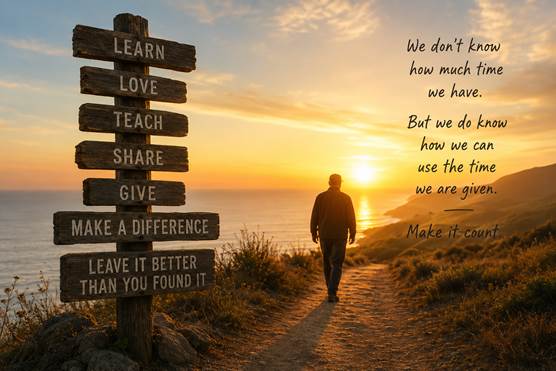
Hopefully, over the course of a lifetime, we can build a life containing some combination of love, meaning, purpose, contribution, friendship, family, learning, service, and perhaps even a little wisdom. We certainly will not succeed every day. There will be periods when simply getting through a difficult time is accomplishment enough. There will also be days when we need to rest, step away, or allow someone else to help us. But when viewed across the longer arc of a life, I think there is something worthwhile about trying to leave the world, or at least our small corner of it, a little better because we were here.

What Is the Point?

Every so often, I encounter someone who expresses a very different perspective. They may say something along the lines of, “What is the point? We are all going to die anyway.” Technically, they are correct.

Every person reading these words will eventually die. So will I. Every generation before us has faced the same reality, and every generation after us will face it as well. No amount of exercise, money, medicine, education, spiritual practice, healthy eating, positive thinking, or modern technology has changed that basic fact. But to me, that is exactly the point.

If our time were unlimited, there might be much less urgency to do anything meaningful with it. We could always begin tomorrow. The book could be written someday. The old friend could be called eventually. We could apologize later, tell someone we love them another time, take better care of ourselves next year, or finally begin sharing what we have learned when the timing seems more convenient.

The problem is that we do not actually know how many tomorrows we will have.

None of us knows when our last breath will occur. I do not see that realization as necessarily depressing or morbid. In fact, I think it can be quite motivating. The awareness that our time is limited can help us separate what is important from what merely consumes our attention. Research in psychology has long suggested that awareness of mortality can influence how people think about meaning, identity, relationships, and values (Greenberg et al., 1986). Other research has found that having a sense of purpose is associated with important aspects of psychological and physical well-being across adulthood (Hill & Turiano, 2014).

The objective, then, is not to become preoccupied with death. It is to become more engaged with life.

What If All of This Actually Matters?

None of us possesses absolute certainty about the ultimate meaning of existence. Philosophers, scientists, theologians, mystics, and ordinary people have debated these questions for thousands of years. We continue to wonder why we are here, whether life has some larger purpose, what happens when consciousness ends, and whether meaning is something we discover or something we create for ourselves. I certainly do not claim to know the answers to those questions.

Somewhere along the way, however, I arrived at a practical conclusion that works for me. Why not err on the positive side? What if all of “this” actually matters?

Perhaps the encouragement we give another person matters. Maybe teaching someone an exercise that improves their balance or mobility can have a positive effect. Showing someone how to slow their breathing when they are overwhelmed may help that person considerably. Sharing an experience that prevents someone else from repeating one of our mistakes may matter considerably more than we realize at the time.

A conversation might change someone’s perspective. An article might reach someone we will never meet. A book could sit on a shelf for years before eventually being opened by the person who needs what is written inside it. A video that receives relatively little attention today might someday help someone halfway around the world.

We may never know. That does not mean it did not matter.

Purpose Does Not Have to Be Grand

I think one mistake we sometimes make is assuming that purpose has to involve something enormous. The phrase “life purpose” can conjure images of changing the world, becoming famous, creating a movement, building an empire, or somehow being remembered generations after we die. Most meaningful lives probably do not look anything like that.

Purpose is often remarkably ordinary. It can be found in raising children, caring for an aging parent, teaching a class, helping a neighbor, creating something useful, sharing knowledge, volunteering in the community, mentoring someone younger, or simply being available when another human being needs someone to listen to.

Psychiatrist Viktor Frankl wrote extensively about the human search for meaning, particularly through his experiences of extraordinary suffering. His work emphasized that meaning can be found through what we create and contribute, through what we experience and whom we love, and through the attitudes we adopt toward circumstances that cannot be changed (Frankl, 2006).

I have always appreciated that perspective because it places meaning within reach of ordinary people living ordinary lives. We do not necessarily have to save humanity to live meaningfully. Sometimes we simply help the people who happen to be within our reach.

Expanding the Circle

As I have gotten older, this idea has increasingly influenced how I choose to spend my time. It manifests itself in my desire to reach more people, teach more classes, offer more perspectives, and share more of what I have learned and experienced. It is also one of the reasons I continue writing articles and books and creating videos for people whom I may never have an opportunity to meet personally.

This is not because I believe I possess all the answers. Quite the opposite. The longer I live and continue learning, the more aware I become of how much there still is to understand.

But I have accumulated experiences. I have made mistakes, changed my mind, been taught by many people, watched ideas come and go, and seen things that I once believed to be true turn out to be incomplete, exaggerated, misunderstood, or simply incorrect. At the same time, I have watched seemingly simple lessons become much more meaningful as I grew older and finally accumulated enough life experience to understand them differently. At some point I began asking myself, why keep all of that to myself?

Teaching in person has always been meaningful to me because there is an immediate human connection. You can see whether someone understands what you are explaining. You can modify what you are doing, answer questions, demonstrate an exercise differently, laugh together, and watch people gradually improve. But there are obvious limitations. Any one of us can only teach so many classes, be in one room at a time, and personally interact with a limited number of people during the course of a day. Writing and modern technology extend that circle considerably.

An article can travel somewhere I cannot. A book can continue communicating an idea when I am somewhere else doing something entirely different. A video can demonstrate an exercise to someone who may never attend one of my classes. Something created today might remain available years from now.

The internet certainly has its problems, particularly in today’s cultural climate. We are surrounded by enormous amounts of information, misinformation, advertising, anger, entertainment, distraction, and increasingly shorter attention spans. Yet the same technology that spreads nonsense can also spread education, encouragement, experience, and useful ideas. The tool itself is not necessarily the problem. Much depends upon what we choose to do with it.

The Ripple Effect We Rarely See

One of the interesting things about teaching, helping, mentoring, parenting, writing, or simply interacting with other people is that we rarely get to see the full effect of what we do.

A teacher may say something that a student remembers twenty years later. A parent may offer advice that a child dismisses at twenty but suddenly understands at forty-five. Someone might read an article, think about one paragraph for several days, and quietly make a change in their life. A person might learn an exercise in a class and later teach it to a spouse, friend, child, or grandchild. The original teacher may never know any of this occurred.

This is worth remembering because we increasingly live in a world where influence is measured through visible numbers. We count attendance, sales, views, likes, subscribers, comments, followers, income, and recognition. Those measurements have their place, but they cannot possibly measure every form of human influence.

Research on generativity, a concept strongly associated with Erik Erikson’s theory of adult development, describes the human desire to contribute to and guide future generations. Generativity can take many forms, including parenting, mentoring, teaching, leadership, creativity, and community involvement (McAdams & de St. Aubin, 1992).

I find that concept increasingly meaningful as the years pass. At some point, the question can gradually shift from “What can I accumulate?” toward “What can I contribute?” That is a very different way of looking at one’s remaining time.

Earning the Day

Perhaps the idea of “earning the life we live” sounds too ambitious when considered across an entire lifetime. I sometimes find it more useful to reduce the scale and simply think about earning the day.

That does not require accomplishing something extraordinary every twenty-four hours. It might simply mean learning something, helping someone, taking reasonable care of ourselves, appreciating the people around us, creating something rather than merely consuming, or contributing in some small way to the lives of the people we encounter.

Obviously, every day will not look like this. There are days for rest and recovery. There are days when our own problems require most of our attention. There are times when we need other people far more than they need us. This is part of being human. But there is an important difference between allowing ourselves to rest and deciding that nothing matters because everything eventually ends.

A beautiful meal, a great conversation, a vacation, a class, a sunset, childhood and careers end. Relationships eventually end, whether through circumstances, separation, or death. Human life itself eventually ends. Something does not become meaningless simply because it is temporary. In fact, I would argue that its temporary nature may be exactly what gives it value.

If we had an unlimited number of sunsets, years with the people we love, opportunities to repair relationships, time to learn, and unlimited opportunities to say what needs to be said, perhaps we would appreciate these things far less.

Scarcity creates value in many areas of life. Time may be the greatest example of all.

Until the Last Breath

None of us knows how much time remains. Hopefully, there are many years ahead, but there are no guarantees. That reality encourages me to continue doing what I can while I can.

There are still classes I would like to teach, ideas I want to explore, articles I want to write, books I hope to complete, videos I would like to create, people I have yet to meet, and perspectives that I will probably continue changing as I learn more. There are also lessons accumulated over a lifetime that might be useful to someone else, even if I never know who that person is.

Will all of it matter? I cannot prove that it will. But neither can anyone prove that it will not.

Given those two possibilities, I choose to err on the positive side. I would rather live as though kindness, teaching, learning, sharing experiences, taking care of ourselves, helping other people, and loving people matters.

I would rather believe that something we create today might continue helping someone after we are no longer here to explain why we created it. Someday, like everyone else who has walked this earth, I will take my last breath. Between this breath and that final one lies whatever amount of life remains. I would prefer to use as much of it as reasonably possible.

Perhaps I will never know how far the ripples will travel. Perhaps none of us does. But I think there is something worthwhile about continuing to throw a few stones into the water. And perhaps that is part of what it means to earn the life we live.

References

Frankl, V. E. (2006). Man’s search for meaning. Beacon Press. (Original work published 1946)

Greenberg, J., Pyszczynski, T., & Solomon, S. (1986). The causes and consequences of a need for self-esteem: A terror management theory. In R. F. Baumeister (Ed.), Public self and private self (pp. 189–212). Springer.

Hill, P. L., & Turiano, N. A. (2014). Purpose in life as a predictor of mortality across adulthood. Psychological Science, 25(7), 1482–1486.

McAdams, D. P., & de St. Aubin, E. (1992). A theory of generativity and its assessment through self-report, behavioral acts, and narrative themes in autobiography. Journal of Personality and Social Psychology, 62(6), 1003–1015.

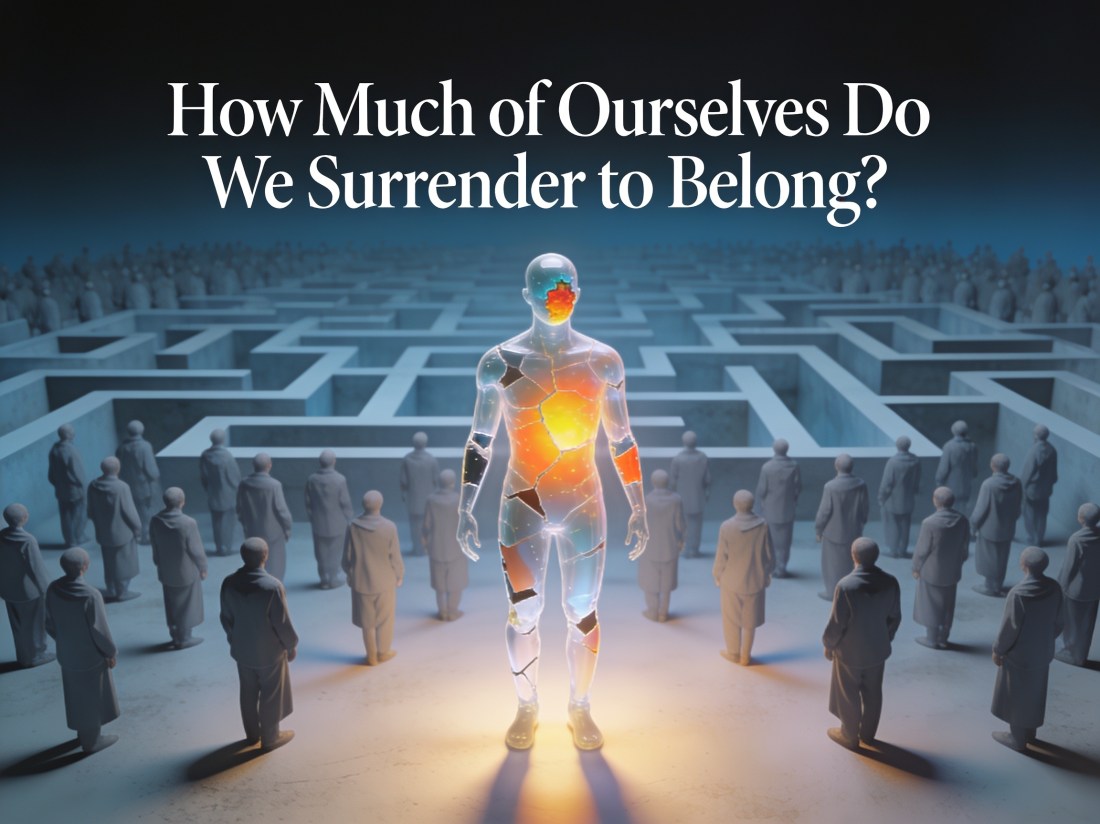
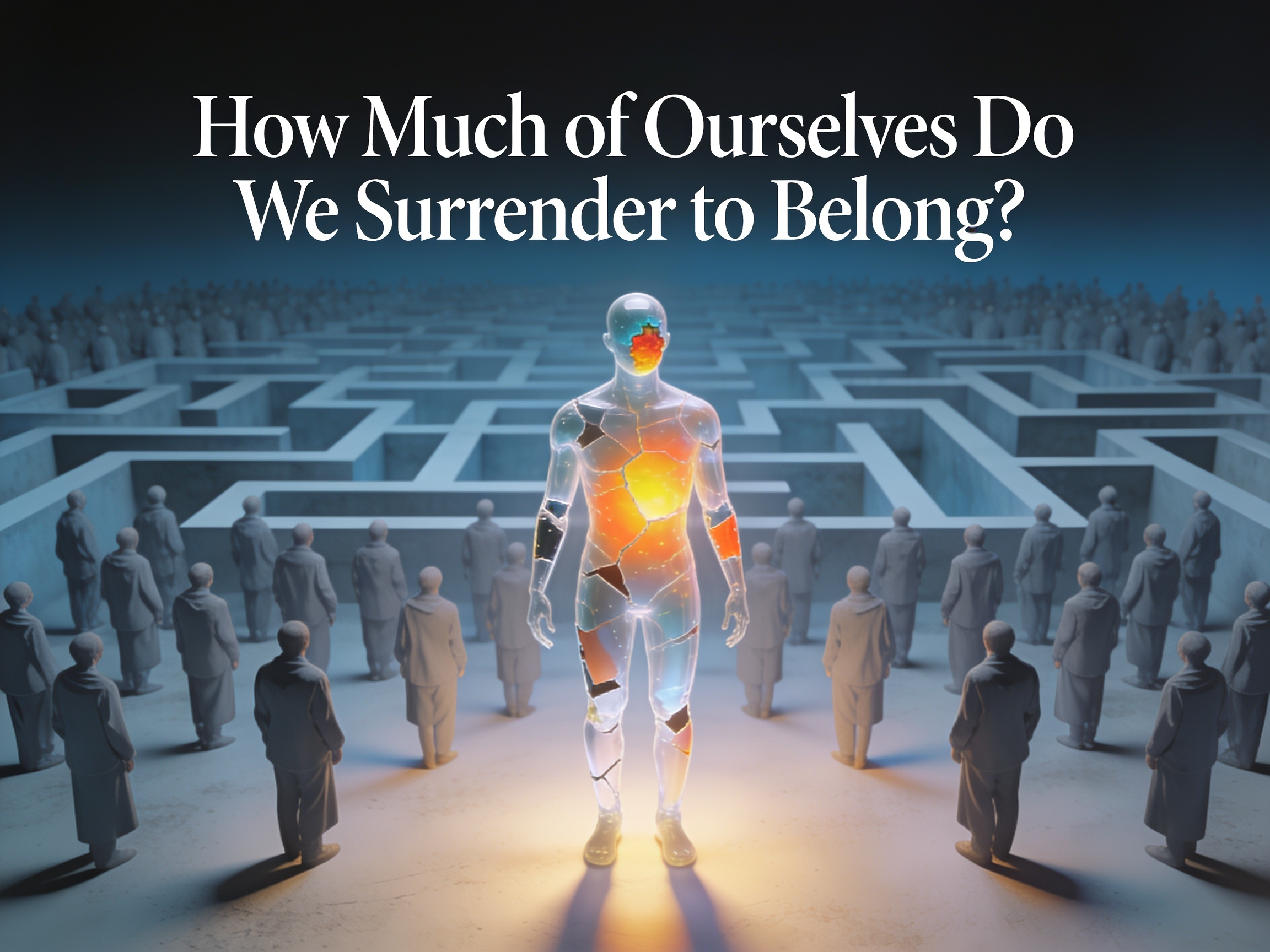
How Much of Ourselves Do We Surrender to Belong?