
Consciousness hygiene is not a formal scientific term, but it is increasingly used in psychology, philosophy, meditation traditions, and holistic health to describe the deliberate management and care of one’s mental and perceptual environment, much like physical hygiene refers to caring for the body.
In simple terms:
Consciousness hygiene = practices that keep the mind clear, balanced, and resilient.
It involves being mindful about what enters, circulates within, and exits the mind.
For anyone with a background in holistic health, martial arts, and Eastern philosophy, the concept aligns very closely with principles found in Daoist cultivation, Buddhist mindfulness, and Stoic philosophy, even though the modern term itself is relatively new.
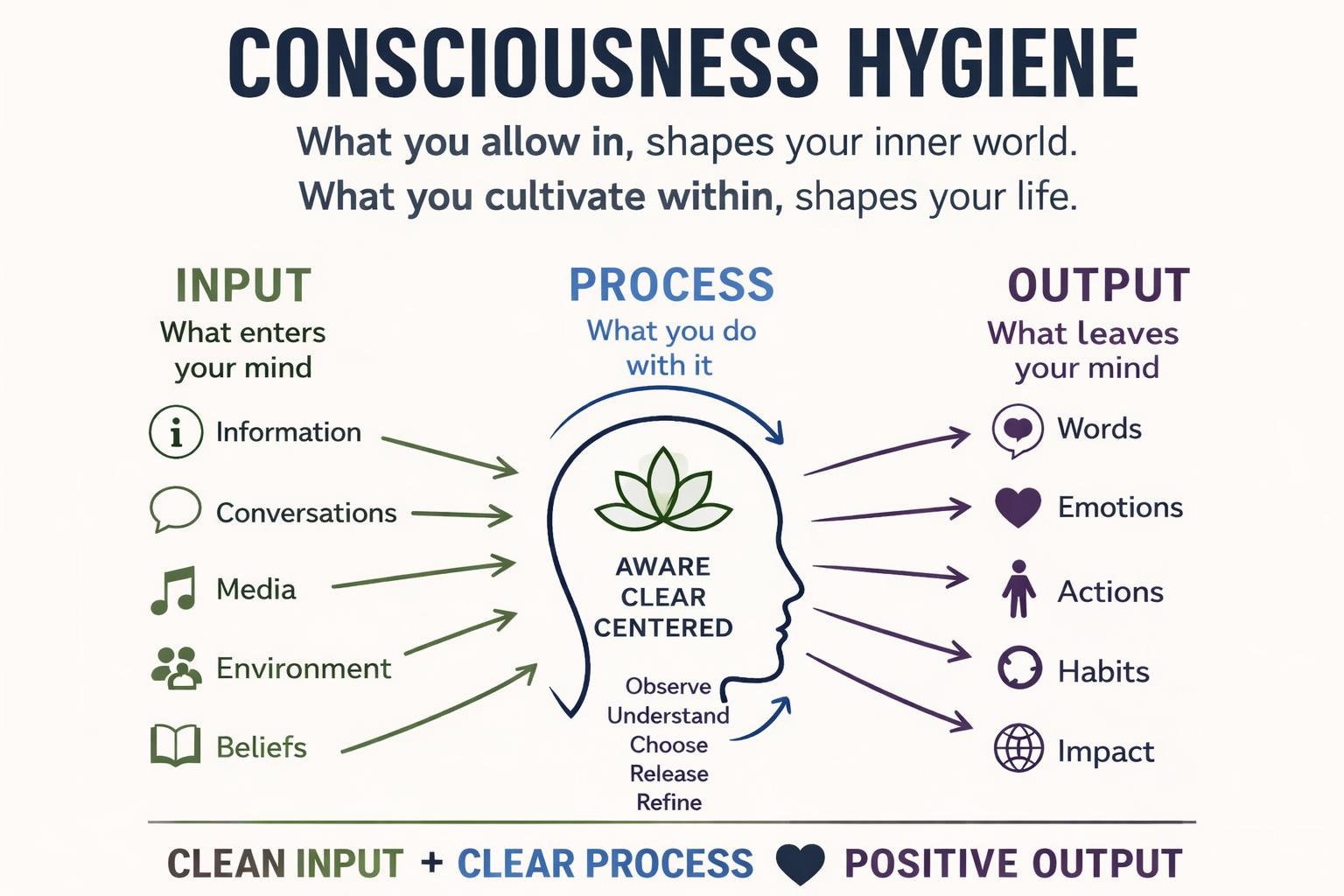
1. The Basic Idea: The Mind Also Needs Hygiene
Just as the body requires:
- clean food
- clean air
- movement
- rest
The mind requires similar care.
Without intentional care, the mind becomes cluttered with:
- excessive information
- emotional residue
- negative conditioning
- media overload
- stress loops
Modern psychology often refers to this as cognitive load or mental contamination. In a holistic sense, consciousness hygiene asks:
- What are you feeding your mind?
- What thoughts are you repeating?
- What emotional states are you cultivating?
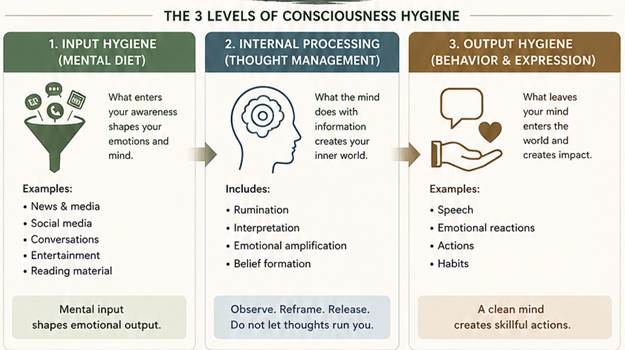
2. Three Levels of Consciousness Hygiene
Many thinkers describe it in three stages.
Level 1 – Input Hygiene (Mental Diet)
What enters your awareness.
Examples include:
- news consumption
- social media
- conversations
- music and entertainment
- reading material
Research shows that excessive exposure to negative media increases anxiety, stress hormones, and perceived threat levels (Garfin, Silver, & Holman, 2020).
In practical terms:
Mental input shapes emotional output.
This aligns strongly with the martial arts idea of guarding the gates of perception.
Level 2 – Internal Processing (Thought Management)
What the mind does with incoming information.
This includes:
- rumination
- interpretation
- emotional amplification
- belief formation
Cognitive psychology shows that humans tend toward negativity bias, meaning the brain naturally prioritizes threat-related information (Baumeister et al., 2001).
Consciousness hygiene therefore includes:
- reframing thoughts
- observing internal dialogue
- preventing mental spirals
In meditation traditions, this is simply watching the mind without attachment.
Level 3 – Output Hygiene (Behavior and Expression)
What leaves the mind and enters the world.
Examples include:
- speech
- emotional reactions
- actions
- habits
If the mind is cluttered with anger or fear, those emotions leak into behavior.
Healthy consciousness hygiene leads to:
- clearer thinking
- calmer reactions
- intentional behavior
3. Ancient Traditions Already Practiced It
Although the phrase is modern, the practice is ancient.
Taoism
Taoist cultivation emphasized:
- regulating thoughts
- calming emotional turbulence
- circulating qi
Practices such as Dao Yin, breath regulation, and quiet sitting were methods of clearing the mind.
Buddhism
Buddhist teachings describe mental purification.
Meditation trains awareness to observe:
- craving
- aversion
- delusion
These are considered pollutants of consciousness.
Stoicism
Stoic philosophers like Epictetus and Marcus Aurelius emphasized controlling:
- perceptions
- judgments
- emotional reactions
Their view:
Disturbance comes not from events, but from the judgments we make about them.
This is essentially cognitive hygiene.
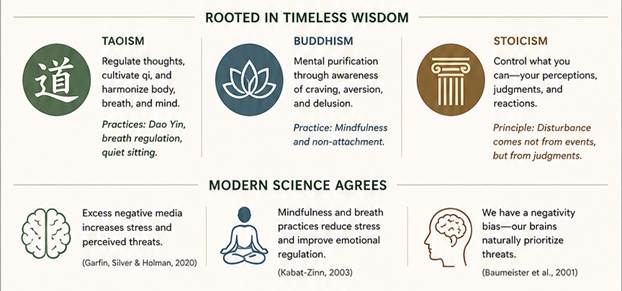
4. Modern Psychological Parallels
Modern research touches the same concept using different terminology.
Relevant areas include:
- Mindfulness training
- Cognitive behavioral therapy (CBT)
- Stress inoculation
- Emotional regulation
Mindfulness practices, for example, have been shown to reduce stress and improve emotional regulation (Kabat-Zinn, 2003).
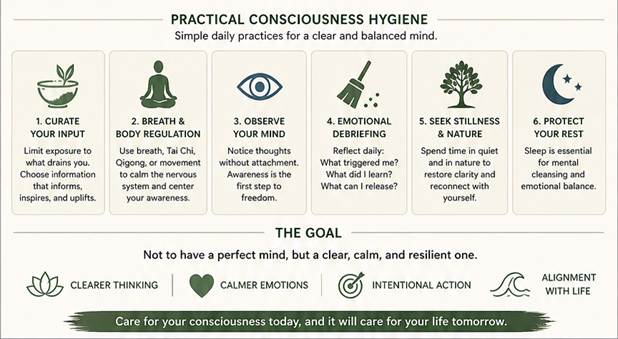
5. Practical Examples of Consciousness Hygiene
Daily practices might include:
Mental Diet
Limiting exposure to:
- sensational news
- toxic social media
- constant information flow
Breath and Body Regulation
Practices such as:
- meditation
- Tai Chi
- Qigong
- controlled breathing
These calm the autonomic nervous system and reduce stress.
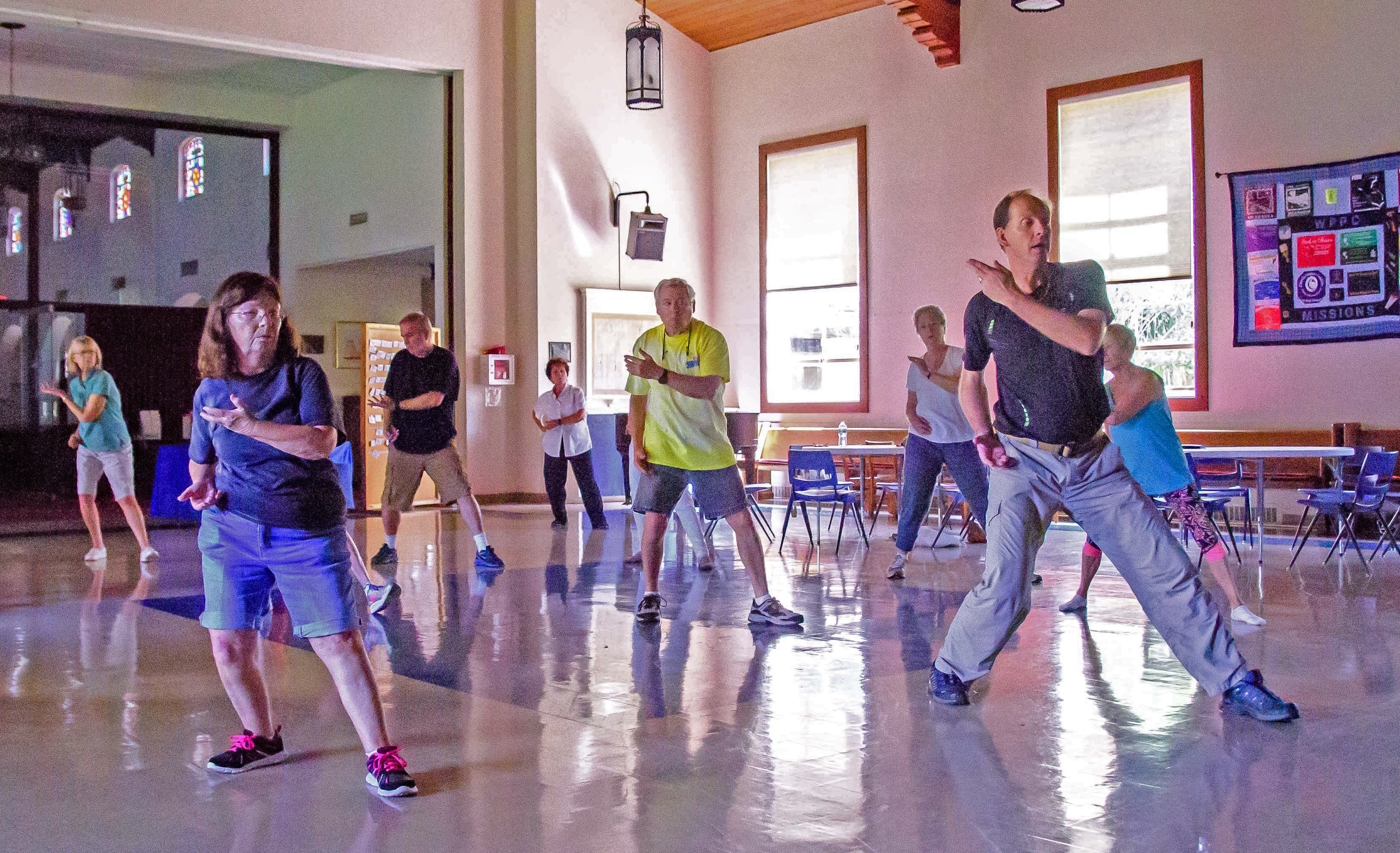
Tai Chi and qigong, these practices are actually classic methods of consciousness hygiene, even though they are often described as physical exercise.
Emotional Debriefing
Reflecting on the day:
- What triggered me?
- What did I learn?
- What should I release?
Mental Stillness
Moments of quiet:
- meditation
- walking in nature
- silent reflection
These clear cognitive overload.
6. Why Consciousness Hygiene Matters Today
Modern humans are exposed to more information in a single day than people centuries ago experienced in weeks.
Without conscious filtering, this leads to:
- chronic stress
- anxiety
- attention fragmentation
- emotional reactivity
Therefore, consciousness hygiene is becoming increasingly important.
It is essentially self-defense for the mind.
7. A Simple Definition
A concise way to describe it is:
Consciousness hygiene is the intentional practice of protecting, regulating, and refining the contents of one’s awareness.
It includes:
- managing mental inputs
- regulating internal thoughts
- cultivating healthy emotional states
In many ways, Tai Chi, breathwork (managed breathing), and Dao Yin are forms of consciousness hygiene.
The slow movement, breath coordination, and attention training all serve to clean the mind while regulating the nervous system.
References
Baumeister, R. F., Bratslavsky, E., Finkenauer, C., & Vohs, K. D. (2001). Bad is stronger than good. Review of General Psychology, 5(4), 323–370. https://doi.org/10.1037/1089-2680.5.4.323
Garfin, D. R., Silver, R. C., & Holman, E. A. (2020). The novel coronavirus (COVID-2019) outbreak: Amplification of public health consequences by media exposure. Health Psychology, 39(5), 355–357. https://doi.org/10.1037/hea0000875
Kabat-Zinn, J. (2003). Mindfulness-based interventions in context: Past, present, and future. Clinical Psychology: Science and Practice, 10(2), 144–156. https://doi.org/10.1093/clipsy.bpg016
 United Martial Arts Association