
It is difficult not to feel that society has been on a downward trajectory for decades. With age, experience, and a broader view of human behavior, patterns begin to emerge that were once invisible. What once appeared stable and trustworthy can begin to show cracks. Professions that were historically held in high regard, such as medicine, law, education, law enforcement, and clergy, now seem increasingly associated with scandal, ethical lapses, and questionable conduct.
To be clear, this is not an indictment of the majority. Most individuals within these professions still operate with integrity and a sincere desire to serve. Yet the perception remains that something has shifted, that the moral compass guiding society is no longer as steady as it once was.
This raises an important question. Are we truly in moral decline, or are we simply seeing more clearly?
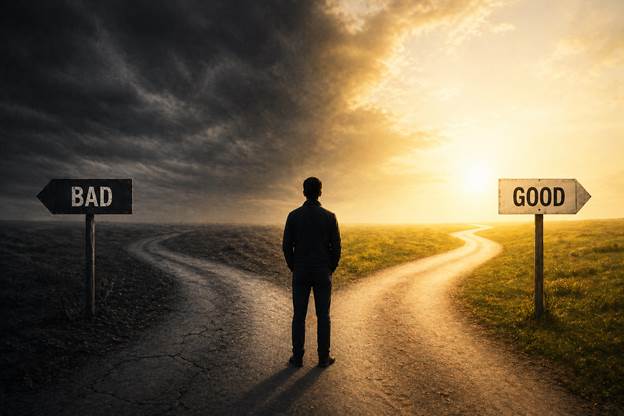
A Timeless Concern
The belief that society is deteriorating is not unique to the modern era. Throughout history, thinkers have expressed concern about the erosion of values and virtue. Socrates criticized the moral direction of Athenian youth, while Confucius lamented the loss of social harmony and ethical conduct in his time. Even during the decline of the Roman Empire, writers pointed to corruption, excess, and the weakening of civic responsibility as signs of societal decay (Grant, 1990).
This recurring narrative suggests that the perception of decline may be, at least in part, a function of awareness. As individuals mature, they become more attuned to inconsistency, hypocrisy, and systemic flaws. What once went unnoticed now becomes difficult to ignore.
The Amplification Effect of Modern Media
One of the most significant differences between past and present is the role of media. In today’s world, information travels instantly and globally. Ethical failures that would have once remained local are now broadcast widely, often repeatedly. This creates what can be described as an amplification effect.
Research in media psychology has shown that repeated exposure to negative news can distort perception, leading individuals to believe that negative behaviors are more common than they actually are (Soroka et al., 2019). This does not mean that corruption does not exist. It clearly does. However, its visibility has increased exponentially, which can create the impression that it is more pervasive than it truly is.
Declining Trust in Institutions
At the same time, there is evidence to support the notion that trust in institutions has declined. Longitudinal surveys have shown decreasing public confidence in major societal institutions, including government, healthcare, and organized religion (Pew Research Center, 2022). This erosion of trust can foster skepticism and cynicism, further reinforcing the belief that moral standards are slipping.
However, declining trust does not necessarily equate to declining morality at the individual level. It may instead reflect growing dissatisfaction with large, complex systems that feel increasingly disconnected from the people they serve.
Everyday Ethics and the Expectation of Selfishness
A common sentiment is that the average person today would be unlikely to return a lost wallet or act in a selfless manner. Interestingly, empirical research challenges this assumption. A large-scale field experiment conducted across multiple countries found that rates of honest behavior, such as returning lost wallets, were higher than most people predicted (Cohn et al., 2019).
This suggests that while ethical behavior persists, our expectations of others may have shifted. We have become conditioned to anticipate selfishness, and when honesty does appear, it is perceived as exceptional rather than normal.
The Role of Negativity Bias
Part of this perception can be explained by what psychologists refer to as negativity bias. Humans are naturally inclined to pay more attention to negative information than positive information. From an evolutionary standpoint, this bias enhanced survival by making individuals more alert to threats (Baumeister et al., 2001).
In a modern context, however, this bias can lead to a distorted view of reality. Acts of kindness, honesty, and cooperation often go unnoticed, while instances of corruption or wrongdoing dominate attention and memory.
Are We Losing Our Humanity?
This brings us to a deeper philosophical question. If we are increasingly driven by impulse, self-interest, and short-term gain, are we becoming no different than animals operating on instinct?
Human beings possess both instinctual drives and the capacity for higher-order thinking. The distinction lies in our ability to observe, reflect, and choose our actions consciously. Philosophical traditions such as Virtue Ethics emphasize the cultivation of character, while Stoicism teaches that although we cannot control external events, we retain full control over our responses to them (Pigliucci, 2017).
From this perspective, the state of society becomes secondary to the conduct of the individual. Regardless of external conditions, one retains the ability to act with integrity, honesty, and compassion.
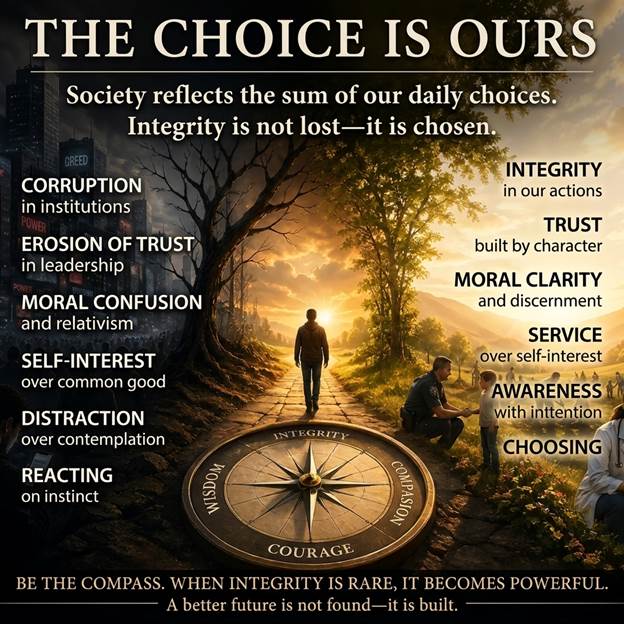
A Holistic Perspective: Responsibility Over Reaction
From a holistic standpoint, the question is not simply where society is headed, but how each individual contributes to that direction. Culture is not an abstract force. It is the cumulative result of individual behaviors repeated over time.
If there is a perceived decline in moral standards, the most meaningful response is not resignation, but responsibility. The choice to act with integrity, to return the lost wallet, to help another person without expectation, becomes more significant in an environment where such actions appear less common.
In this sense, times of perceived moral uncertainty present an opportunity. When integrity becomes less visible, it also becomes more impactful.
Conclusion
History suggests that humanity does not move in a straight line of progress or decline. Rather, it oscillates between higher and lower expressions of human nature. While modern society faces unique challenges, it also offers unprecedented opportunities for awareness, reflection, and growth.
The moral compass of society may feel unsteady, but it has not disappeared. It exists within individuals, shaped by daily choices and reinforced through consistent action.
The question is not only where society is headed, but what role each of us will play in determining that direction.
References
Baumeister, R. F., Bratslavsky, E., Finkenauer, C., & Vohs, K. D. (2001). Bad is stronger than good. Review of General Psychology, 5(4), 323–370. https://doi.org/10.1037/1089-2680.5.4.323
Cohn, A., Maréchal, M. A., Tannenbaum, D., & Zünd, C. L. (2019). Civic honesty around the globe. Science, 365(6448), 70–73. https://doi.org/10.1126/science.aau8712
Grant, M. (1990). The fall of the Roman Empire. Scribner. https://archive.org/details/fallofromanempir0000gran_y8b7
Pew Research Center. (2022). Public trust in government: 1958–2022. https://www.pewresearch.org
Pigliucci, M. (2017). How to be a Stoic: Using ancient philosophy to live a modern life. Basic Books.
Soroka, S., Fournier, P., & Nir, L. (2019). Cross-national evidence of a negativity bias in psychophysiological reactions to news. Proceedings of the National Academy of Sciences, 116(38), 18888–18892. https://doi.org/10.1073/pnas.1908369116


 United Martial Arts Association