
A Holistic Perspective on Mind–Body Awareness
The goal of many mind–body practices is not simply improved flexibility, strength, or relaxation. At a deeper level, these systems aim to refine perception itself. They seek to help the individual more clearly see their true nature, better understand the nature of reality, and perhaps most challenging of all, begin to see themselves as others experience them.
This is not a casual endeavor. It requires deliberate self-cultivation through the body, the breath, and the mind. Across traditions, from the teachings of Laozi to the psychological insights of Carl Jung, the message remains consistent: clarity is not given, it is cultivated.
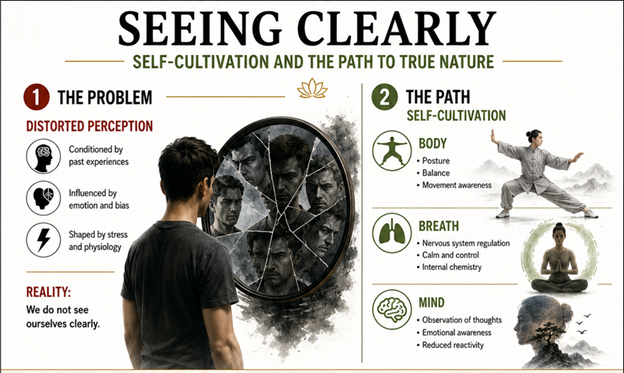
The Problem: Distorted Self-Perception
Human perception is rarely objective. Most individuals operate within layers of conditioning shaped by upbringing, culture, emotional experience, and cognitive bias. These filters influence how we interpret both ourselves and the world around us.
Modern psychology identifies several mechanisms that contribute to this distortion. The self-serving bias leads individuals to interpret events in ways that protect their self-image, while the blind spot bias prevents people from recognizing their own biases (Pronin et al., 2002). Jung (1968) described this phenomenon through the concept of the shadow, the unconscious aspects of the personality that remain hidden from conscious awareness.
From a physiological perspective, perception is also influenced by the state of the nervous system. Chronic stress, poor breathing patterns, and physical tension can alter emotional regulation and cognitive clarity (Porges, 2011). In Traditional Chinese Medicine (TCM), this would be described as a disturbance of the Shen, the aspect of mind and spirit responsible for clarity and awareness.
The result is a fundamental reality: Most people do not see themselves clearly.
The Method: Self-Cultivation Through the Body
Embodied Awareness
Mind–body systems begin with the body because the body provides immediate, honest feedback. Unlike thought, which can rationalize or distort, physical experience reveals truth directly.
Practices such as Tai Chi, Qigong, Dao Yin, yoga, and structured stance training develop:
- Postural awareness
- Balance and coordination
- Sensitivity to tension and restriction
- Breath-body integration
Through these methods, individuals begin to notice patterns that were previously unconscious. Tightness in the shoulders, shallow breathing, or instability in posture often correlate with emotional and psychological states.
This process enhances interoception, the ability to sense internal bodily states, which is strongly associated with emotional regulation and self-awareness (Craig, 2009).
The Bridge: Breath and the Nervous System
Breathing practices serve as a critical bridge between body and mind.
Slow, controlled breathing, particularly through the nose, has measurable physiological effects. It increases nitric oxide production, supports vascular function, and promotes parasympathetic nervous system activation, which is associated with relaxation and recovery (Porges, 2011).
From a holistic perspective, breath regulation is a method of accessing what can be described as the body’s inner pharmacy. Rather than relying solely on external interventions, individuals learn to influence internal chemistry through conscious regulation.
In practical terms, this leads to:
- Reduced stress reactivity
- Improved emotional stability
- Greater clarity of thought
The Mind: Observation and Deconstruction
As physical and physiological awareness increases, attention naturally turns inward toward the mind.
Meditative and reflective practices reveal several key insights:
- Thoughts are continuous and often repetitive
- Emotional responses arise automatically
- Identity is frequently tied to patterns rather than objective reality
In both Eastern philosophy and Western psychology, this process involves recognizing the difference between awareness and the contents of awareness.
Jung referred to this as part of the individuation process, where unconscious material becomes integrated into conscious awareness (Jung, 1968). Similarly, contemplative traditions emphasize the importance of observing thought without immediate identification.
Over time, this reduces reactivity and increases the capacity for deliberate response.

Seeing Oneself Through the Eyes of Others
One of the most difficult aspects of self-cultivation is recognizing the gap between self-perception and how others experience us.
Individuals often believe they are calm, kind, or disciplined, yet their tone, posture, or behavior may communicate something entirely different. This discrepancy is explored in psychology through models such as the Johari Window, which highlights the existence of blind spots in self-awareness.
Mind–body practices help bridge this gap by:
- Increasing sensitivity to internal states before they manifest externally
- Reducing impulsive reactions
- Encouraging openness to feedback
As awareness deepens, feedback from others becomes less threatening and more informative, allowing for continued refinement of perception and behavior.
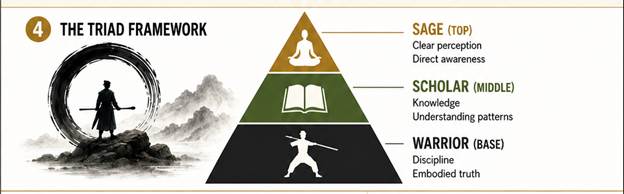
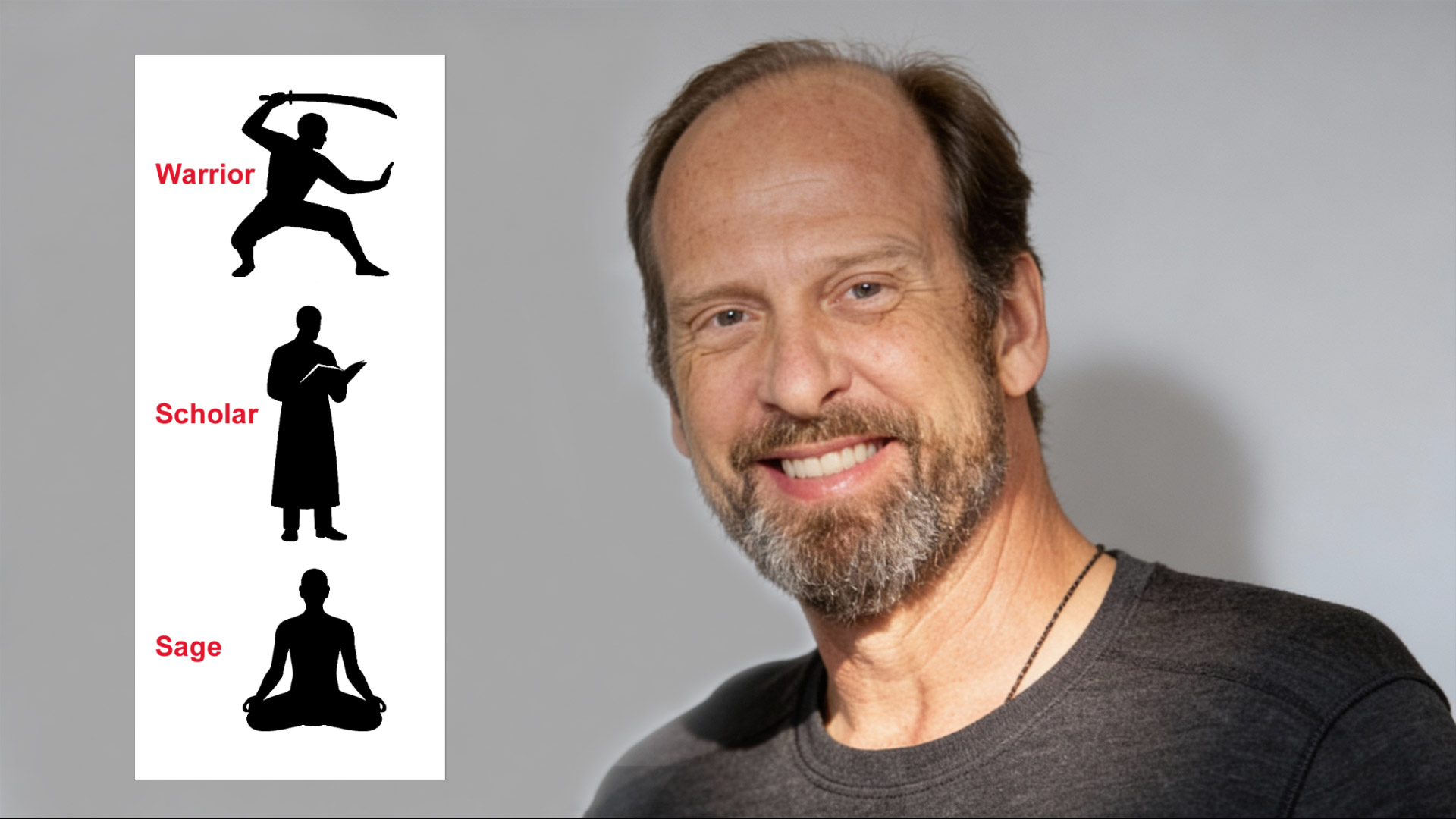
The Warrior, Scholar, and Sage
This process can be understood through three integrated dimensions:
The Warrior: Embodied Truth
The Warrior trains the body and confronts physical reality directly. There is no illusion in maintaining a stance, controlling breath under stress, or sustaining effort over time.
The Scholar: Cognitive Understanding
The Scholar studies patterns, philosophy, and psychology. Knowledge provides frameworks for interpreting experience but must be grounded in practice.
The Sage: Direct Perception
The Sage observes without distortion. Through sustained practice, perception becomes less clouded by bias, emotion, and conditioning.
Together, these three aspects form a complete system of self-cultivation, integrating action, understanding, and awareness.
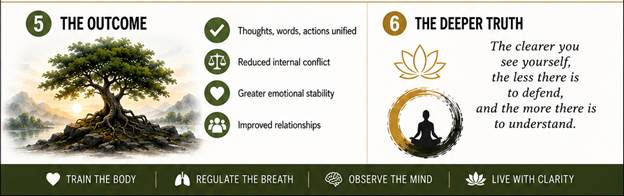
The Outcome: Alignment and Clarity
As these practices are developed consistently, several changes begin to emerge:
- Greater alignment between thoughts, words, and actions
- Reduced internal conflict
- Increased emotional regulation
- Enhanced empathy and understanding of others
From a psychological perspective, this reflects increased self-efficacy (Bandura, 1997) and movement toward self-actualization (Maslow, 1943).
The individual becomes less reactive and more responsive, less fragmented and more integrated.
The Deeper Realization
There is a paradox at the heart of this process.
Initially, the goal is to discover one’s true self. However, as awareness deepens, the concept of a fixed, unchanging self begins to dissolve. What is revealed instead is a dynamic process of experience—constantly shifting, influenced by both internal and external conditions.
This realization is echoed across traditions. It does not diminish the importance of self-cultivation; rather, it refines it.
The clearer one sees, the less there is to defend, and the more there is to understand.
In conclusion, most people attempt to change their external circumstances without first addressing the distortions in their own perception. Mind–body practices reverse this process by beginning within.
Through training the body, regulating the breath, and observing the mind, individuals develop the capacity to see more clearly. This clarity leads to more appropriate action, improved relationships, and a greater sense of alignment with both self and environment.
Ultimately, self-cultivation is not about becoming something new. It is about removing what obscures what is already present.
References
Bandura, A. (1997). Self-efficacy: The exercise of control. W.H. Freeman.
Craig, A. D. (2009). How do you feel—now? The anterior insula and human awareness. Nature Reviews Neuroscience, 10(1), 59–70. https://doi.org/10.1038/nrn2555
Jung, C. G. (1968). The archetypes and the collective unconscious (2nd ed.). Princeton University Press.
Maslow, A. H. (1943). A theory of human motivation. Psychological Review, 50(4), 370–396. https://doi.org/10.1037/h0054346
Porges, S. W. (2011). The polyvagal theory: Neurophysiological foundations of emotions, attachment, communication, and self-regulation. W.W. Norton & Company.
Pronin, E., Lin, D. Y., & Ross, L. (2002). The bias blind spot: Perceptions of bias in self versus others. Personality and Social Psychology Bulletin, 28(3), 369–381. https://doi.org/10.1177/0146167202286008


… reposted this!
LikeLike
… reposted this!
LikeLike
… reposted this!
LikeLike
… reposted this!
LikeLike
… reposted this!
LikeLike
… reposted this!
LikeLike
… reposted this!
LikeLike
… reposted this!
LikeLike
… reposted this!
LikeLike
… reposted this!
LikeLike
… reposted this!
LikeLike
… reposted this!
LikeLike
… reposted this!
LikeLike
… reposted this!
LikeLike
… reposted this!
LikeLike
… reposted this!
LikeLike