
For decades, we have been told that climate change represents one of the greatest challenges facing humanity. Governments, businesses, and individuals have been encouraged to reduce energy consumption, lower carbon emissions, purchase more efficient appliances, drive fuel-efficient vehicles, and adopt sustainable practices. Entire industries have emerged around renewable energy, green building technologies, and environmental consulting. Trillions of dollars have been invested globally in efforts aimed at reducing humanity’s environmental footprint.
Yet today, a new technological race is underway.
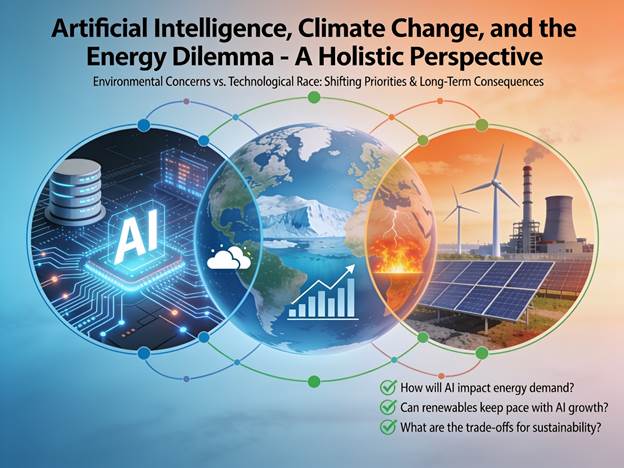
Artificial intelligence has rapidly become one of the most influential and potentially transformative technologies in human history. The race to develop increasingly powerful AI systems has sparked unprecedented investment in data centers, computing infrastructure, electrical generation, and supporting technologies. What is particularly interesting from a holistic perspective is how quickly public attention has shifted. The environmental concerns that dominated headlines for years now seem to share the stage with a new priority: technological superiority.
This shift raises important questions about energy, sustainability, economics, and the long-term consequences of our collective choices.
The New Energy Frontier
Artificial intelligence does not operate in a vacuum. Behind every AI-generated image, language model response, recommendation algorithm, or automated system lies an enormous amount of computing power. These systems require vast data centers containing thousands of processors operating around the clock. These facilities consume significant amounts of electricity while generating substantial heat that must be removed through sophisticated cooling systems.
As AI adoption accelerates, so does the demand for electrical power. According to the International Energy Agency (IEA, 2024), global electricity demand from data centers is expected to increase substantially over the coming decade, driven largely by artificial intelligence applications.
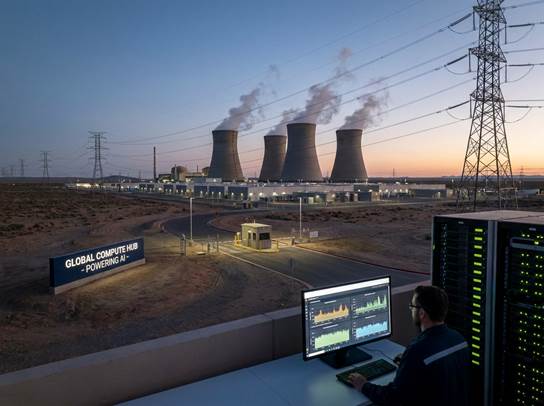
This expansion is creating economic opportunities. Construction companies, engineers, utility providers, software developers, and technology firms are all benefiting from the rapid growth of AI infrastructure. Entire regions are competing to attract new data centers due to the jobs, tax revenue, and economic development they can bring. However, every growth opportunity carries associated costs.
From a systems perspective, increasing electrical demand requires additional power generation, expanded transmission networks, upgraded substations, and ongoing maintenance of infrastructure. These realities exist regardless of whether the electricity is generated through fossil fuels, renewable energy, nuclear power, or some combination thereof.
The Aging Electrical Grid
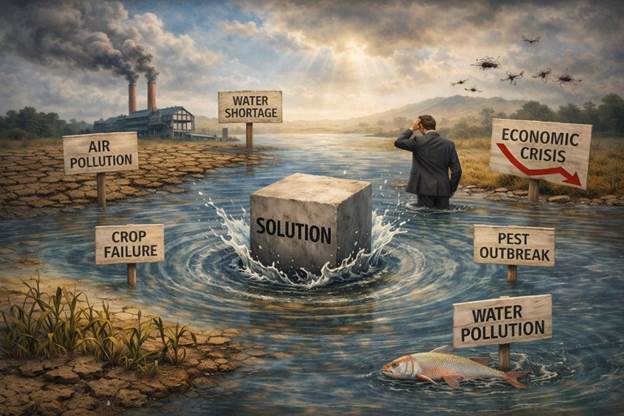
The United States already faces significant challenges related to its aging electrical infrastructure. Much of the nation’s power grid was built decades ago and was not designed for the modern demands of electric vehicles, distributed renewable energy systems, electrified buildings, and AI-driven computing centers.
The American Society of Civil Engineers (2025) continues to identify portions of the nation’s electrical infrastructure as requiring substantial modernization investments. Grid reliability, transmission capacity, and resilience to extreme weather events remain ongoing concerns.
Adding AI-driven energy demands to an already strained system creates a complicated equation. More power plants may be required. Additional transmission lines will likely need to be constructed. Energy storage technologies must continue to improve. Policymakers, utility companies, and consumers will ultimately face difficult decisions regarding costs and priorities.
This reality illustrates an important holistic principle: solving one problem often creates new challenges that must also be addressed.
The Climate Contradiction
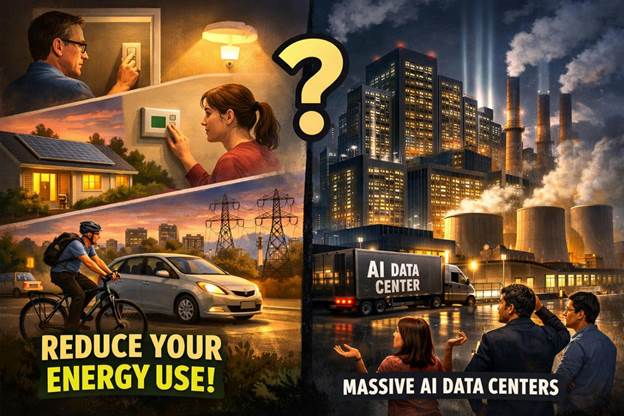
Many people understandably perceive a contradiction. For years, individuals were encouraged to reduce their personal energy consumption. They were told to turn off lights, reduce vehicle emissions, improve home insulation, and lower their carbon footprints. Meanwhile, massive AI data centers are being constructed that may consume electricity equivalent to that used by entire communities. From a public perception standpoint, this can appear inconsistent.
However, proponents of AI argue that the technology itself may contribute to solutions for environmental challenges. Artificial intelligence is already being used to optimize electrical grids, improve energy efficiency, enhance agricultural productivity, model climate systems, reduce industrial waste, and accelerate scientific research (Rolnick et al., 2022).
In other words, AI may increase energy consumption while simultaneously helping society become more efficient. Whether these benefits ultimately outweigh the costs remains a matter of ongoing debate.
The Geopolitical Reality
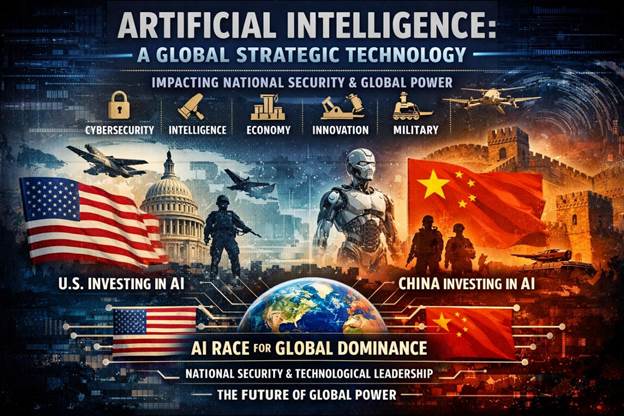
Environmental concerns are only one piece of the puzzle. Artificial intelligence is increasingly viewed as a strategic technology with implications extending far beyond commercial applications. Governments recognize its potential influence on cybersecurity, intelligence gathering, economic competitiveness, scientific innovation, and military capability.
The United States, China, and numerous other nations are investing heavily in AI development. Policymakers often view AI leadership not simply as an economic advantage but as a matter of national security.
History demonstrates that when nations perceive strategic competition, environmental concerns frequently become secondary priorities. Similar patterns were observed during the Industrial Revolution, the Space Race, and the Cold War. Scientific and technological advancement often accelerates when nations believe their security or economic future depends upon it. This does not necessarily mean that environmental stewardship is abandoned. Rather, competing priorities emerge and must be balanced against one another.
A Holistic Perspective on Progress
From a holistic perspective, this situation reflects a broader challenge that humanity has faced repeatedly throughout history.
Technological advancement often brings tremendous benefits. Modern medicine, transportation, communication systems, and computing technologies have improved quality of life for billions of people. At the same time, every technological breakthrough creates unintended consequences that require thoughtful management.
The question is not whether artificial intelligence is inherently good or bad. Nor is the question whether environmental sustainability is important. The deeper issue concerns balance. Human beings have demonstrated extraordinary ability to create powerful technologies. What often proves more difficult is developing the wisdom necessary to manage those technologies responsibly. Progress without foresight can create new problems even as old ones are solved.
A holistic approach recognizes that economic growth, environmental stewardship, technological innovation, public health, national security, and quality of life are interconnected components of a larger system. Focusing exclusively on one while ignoring the others can produce imbalances that eventually demand correction.
Just as holistic health emphasizes balance within the human body, sustainable progress requires balance within society. Energy production, environmental responsibility, economic opportunity, and technological advancement must be considered together rather than as isolated issues.
In conclusion, the rapid growth of artificial intelligence presents humanity with both remarkable opportunities and significant challenges. AI promises advances in medicine, science, communication, education, and countless other fields. Yet these benefits come with increased demands on energy infrastructure and natural resources.
The apparent tension between climate initiatives and AI expansion highlights a broader reality: modern societies are continually forced to balance competing priorities. Environmental sustainability remains important. Technological innovation remains important. Economic vitality remains important. National security remains important.
The challenge moving forward is not choosing one at the expense of the others. Rather, it is developing enough collective wisdom to pursue technological progress while maintaining responsible stewardship of the resources that sustain us. The future may ultimately depend not on how much power we generate, but on how wisely we choose to use it.
References
American Society of Civil Engineers. (2025). 2025 report card for America’s infrastructure. American Society of Civil Engineers. https://infrastructurereportcard.org
International Energy Agency. (2024). Electricity 2024: Analysis and forecast to 2026. International Energy Agency. https://www.iea.org/reports/electricity-2024
Rolnick, D., Donti, P. L., Kaack, L. H., Kochanski, K., Lacoste, A., Sankaran, K., Ross, A. S., Milojevic-Dupont, N., Jaques, N., Waldman-Brown, A., Luccioni, A. S., Maharaj, T., Sherwin, E. D., Mukkavilli, S. K., Kording, K. P., Gomes, C. P., Ng, A. Y., Hassabis, D., Platt, J. C., … Bengio, Y. (2022). Tackling climate change with machine learning. ACM Computing Surveys, 55(2), 1–96. https://doi.org/10.1145/3485128
United Nations Environment Programme. (2024). Global resources outlook 2024. United Nations Environment Programme. https://www.unep.org/resources/Global-Resource-Outlook-2024


 United Martial Arts Association