
Many people today feel squeezed by rising grocery bills, expensive fuel, and the steady hum of anxiety about the future. That strain is real, and any honest conversation about wellness has to begin by acknowledging it. Yet beneath the complaints about cost lies a quieter question, one that deserves a calm look: how do we decide what is worth paying for?
The Arithmetic Nobody Does
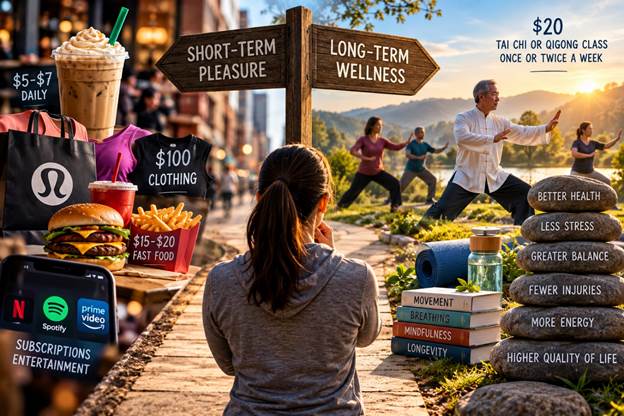
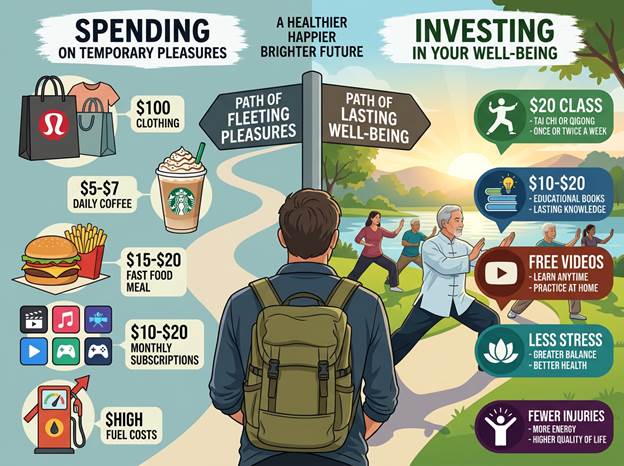
Consider a typical month. A daily specialty coffee at $5 to $7 comes to $150 to $210. Daily fast food at $15 to $20 runs $450 to $600. A single piece of premium athletic wear can cost $100 or more. None of these purchases is wrong, and quality gear can serve you well for years. But set them beside a Tai Chi or qigong class, and the class is often the purchase that gets questioned.
| Habitual purchase | Typical cost | Approximate monthly total |
| Specialty coffee, daily | $5 to $7 | $150 to $210 |
| Fast food, daily | $15 to $20 | $450 to $600 |
| Tai Chi or qigong classes | $20 per class, once or twice weekly | $40 to $200 |
Behavioral economics offers some explanation. People tend to sort money into “mental accounts” and judge each purchase by the account it falls into rather than by its actual value (Thaler, 1999). Coffee lands in the “small daily treat” account, so it barely registers. A class lands in the “health and self-improvement” account, where spending feels deliberate and open to scrutiny. We also discount the future heavily, favoring immediate rewards over larger benefits that arrive later (Laibson, 1997). A sugary drink pays off in minutes, while the payoff of improved balance, calmer nerves, and a resilient body accrues quietly over years.
What the Research Says About Return on Investment
If practices like Tai Chi were merely pleasant, the cost question would be a fair one. The evidence suggests they are considerably more than pleasant.
In a randomized trial published in The New England Journal of Medicine, Tai Chi improved symptoms of fibromyalgia, a chronic pain condition, as much as or more than a standard aerobic exercise program (Wang et al., 2010). In patients with Parkinson’s disease, a Tai Chi program improved postural stability and reduced falls compared with resistance training and stretching (Li et al., 2012). In a trial of adults with knee osteoarthritis, Tai Chi performed at least as well as a standard course of physical therapy for pain relief (Wang et al., 2016). Among people living with persistent low back pain, Tai Chi reduced pain and disability (Hall et al., 2011). In older adults, it has been shown to reduce falls (Li et al., 2005) and improve self-rated sleep quality (Li et al., 2004). Because anxiety and depression are among the most common struggles people name today, it matters that a meta-analysis found Tai Chi associated with meaningful improvements in depression, anxiety, and psychological well-being (Wang et al., 2014).
The financial picture is just as striking. Falls among older adults carried an estimated medical cost of roughly $50 billion in a single year in the United States (Florence et al., 2018). A cost-benefit analysis of fall-prevention programs, including a Tai Ji Quan program, found that such interventions can return more in avoided costs than they require to deliver (Carande-Kulis et al., 2015). A single emergency room visit or orthopedic consultation can easily exceed what a year of weekly classes would cost. This does not mean a class guarantees you will avoid the doctor, since no practice can promise that. But the odds shift in your favor, and that is what prevention means.
Expanded Insight: Prevention Pays Slowly
Prevention is hard to value because its success is invisible. No one receives a bill for the fall that never happened, the injury that never occurred, or the sleepless night that never came. The benefit shows up as an absence, and absences are easy to overlook. A class, in this light, is not purchased for what it gives you this week. It is purchased for the person you are likely to be in five or ten years.
Why “Free” and “Cheap” Can Be Hard to Value
Here is an irony worth naming. Many of us who teach offer a great deal at no cost, including videos, articles, and open discussions, and yet some people still balk at modest fees. Research on pricing helps explain this. People often use price as a signal of quality, and in one well-known study, participants who received a placebo painkiller labeled as higher-priced reported more pain relief than those who received the same pill labeled as discounted (Waber et al., 2008). Meanwhile, a price of zero triggers a distinct emotional reaction that can override a sober assessment of value (Shampanier et al., 2007). Free resources are wonderful entry points, but they ask nothing of us, and what costs us nothing is easy to leave unused. A small commitment, such as a class on the calendar, a book on the shelf, or a teacher expecting you to show up, creates the accountability that turns information into practice.
Answering the Common Objections
Teachers hear a few familiar reasons for hesitation. “I can’t afford it” is sometimes true, and it deserves compassion and creative solutions rather than a lecture. “I don’t have time” is often a question of order rather than hours, since we find time for what we rank highly. “I’ll start when things calm down” may be the most telling, because things rarely calm down on their own. Movement and mindfulness are not rewards for a settled life. They are the tools that help us build one.
There is also the quiet belief that health is something the doctor handles after a problem appears. Medicine is invaluable when we need it, but it is designed largely to repair. Practices like Tai Chi and qigong are designed to maintain. Choosing maintenance early is simply the more economical path, in money and in suffering.
Reframing the Question
The point is not to shame anyone for enjoying a coffee or a well-made pair of leggings. Good gear and small pleasures have their place. The point is to ask what we are actually investing in. Our spending reveals our priorities, and most of us never audit it. Try a simple exercise:
- Track one month of small, habitual purchases.
- Total them and set the sum beside the cost of a class, a book, or a series of lessons.
- Ask honestly which purchases you would make again, and which you made on autopilot.
For some people the numbers will be a surprise. For others, finances may truly be tight, and that is exactly why free videos, library books, and community offerings matter. The aim is a more honest accounting, not guilt.
Starting Small and Starting Now
You do not need to overhaul your budget or your life to begin. A few modest steps can open the door:
- Use free videos and blog articles to learn the basic stance, breathing, and opening movements.
- Attend one class a week and treat it as a standing appointment, as you would a dentist visit.
- Practice ten minutes at home on non-class days, since short, consistent practice builds more than occasional long sessions.
- Choose one habitual purchase each week and redirect that money toward your learning.
Small, repeated choices are how any meaningful change is built, and they are available to nearly everyone.
The Body, Mind, and Spirit Are One Account
From a holistic perspective, the body, mind, and spirit are not separate budgets. Movement steadies the nervous system, a steadier nervous system supports clearer thinking, and clearer thinking supports better choices, including financial ones. Practices like Tai Chi, qigong, and dao yin develop the physical foundation, the mental discipline, and the self-awareness that make a person more resilient when life turns chaotic. The slow, deliberate movement and attention to breath cultivate presence, and presence is the beginning of self-realization. Seen this way, a weekly class is less an expense than a deposit into the one account everything else draws from. Over decades of teaching, I have watched students arrive stiff, stressed, and skeptical, and leave steadier in body and calmer in mind. That change rarely comes from a single class. It comes from showing up, week after week, until the practice becomes part of who you are.
Conclusion
Some people will always be hesitant, and as teachers we cannot persuade everyone. We can keep offering value generously, keep the invitation open, and trust that those who are ready will find their way in. The question each of us eventually faces is simple: Am I willing to invest in myself with the same ease I spend on convenience?
In the end, no one can make this choice for another person. What we can do is hold up an honest mirror, offer the tools freely and fairly, and let each person decide what deserves their attention. Well-being is not a luxury reserved for calmer times. It is the ground we stand on while the world shifts around us.
References
Carande-Kulis, V., Stevens, J. A., Florence, C. S., Beattie, B. L., & Arias, I. (2015). A cost-benefit analysis of three older adult fall prevention interventions. Journal of Safety Research, 52, 65–70. https://doi.org/10.1016/j.jsr.2014.12.007
Florence, C. S., Bergen, G., Atherly, A., Burns, E., Stevens, J., & Drake, C. (2018). Medical costs of fatal and nonfatal falls in older adults. Journal of the American Geriatrics Society, 66(4), 693–698. https://doi.org/10.1111/jgs.15304
Hall, A. M., Maher, C. G., Lam, P., Ferreira, M., & Latimer, J. (2011). Tai chi exercise for treatment of pain and disability in people with persistent low back pain: a randomized controlled trial. Arthritis care & research, 63(11), 1576–1583. https://doi.org/10.1002/acr.20594
Laibson, D. (1997). Golden Eggs and Hyperbolic Discounting. The Quarterly Journal of Economics, 112(2), 443–477. http://www.jstor.org/stable/2951242
Li, F., Fisher, K. J., Harmer, P., Irbe, D., Tearse, R. G., & Weimer, C. (2004). Tai Chi and Self‐Rated Quality of Sleep and Daytime Sleepiness in Older Adults: a randomized controlled trial. Journal of the American Geriatrics Society, 52(6), 892–900. https://doi.org/10.1111/j.1532-5415.2004.52255.x
Li, F., Harmer, P., Fisher, K. J., McAuley, E., Chaumeton, N., Eckstrom, E., & Wilson, N. L. (2005). Tai Chi and fall reductions in older adults: a randomized controlled trial. The journals of gerontology. Series A, Biological sciences and medical sciences, 60(2), 187–194. https://doi.org/10.1093/gerona/60.2.187
Li, F., Harmer, P., Fitzgerald, K., Eckstrom, E., Stock, R., Galver, J., Maddalozzo, G., & Batya, S. S. (2012). Tai Chi and Postural Stability in Patients with Parkinson’s Disease. New England Journal of Medicine, 366(6), 511–519. https://doi.org/10.1056/nejmoa1107911
Shampanier, K., Mazar, N., & Ariely, D. (2007). Zero as a special price: The true value of free products. Marketing Science, 26(6), 742–757. https://doi.org/10.1287/mksc.1060.0254
Thaler, R. H. (1999). Mental accounting matters. Wiley Online Library. https://doi.org/10.1002/(SICI)1099-0771(199909)12:3
Waber, R. L., Shiv, B., Carmon, Z., & Ariely, D. (2008). Commercial features of placebo and therapeutic efficacy. JAMA, 299(9), 1016. https://doi.org/10.1001/jama.299.9.1016
Wang, C., Schmid, C. H., Rones, R., Kalish, R., Yinh, J., Goldenberg, D. L., Lee, Y., & McAlindon, T. (2010). A randomized trial of Tai chi for fibromyalgia. New England Journal of Medicine, 363(8), 743–754. https://doi.org/10.1056/nejmoa0912611
Wang, C., Schmid, C. H., Iversen, M. D., Harvey, W. F., Fielding, R. A., Driban, J. B., Price, L. L., Wong, J. B., Reid, K. F., Rones, R., & McAlindon, T. (2016). Comparative Effectiveness of Tai Chi Versus Physical Therapy for Knee Osteoarthritis: A Randomized Trial. Annals of internal medicine, 165(2), 77–86. https://doi.org/10.7326/M15-2143
Wang, F., Lee, E. K., Wu, T., Benson, H., Fricchione, G., Wang, W., & Yeung, A. S. (2014). The effects of tai chi on depression, anxiety, and psychological well-being: a systematic review and meta-analysis. International journal of behavioral medicine, 21(4), 605–617. https://doi.org/10.1007/s12529-013-9351-9


