
When people are first introduced to the concept of yin and yang, it is easy to see it simply as a philosophy of opposites. Yin is often represented as dark, while yang is light. Yin is stillness, while yang is movement. Yin is inward, while yang is outward. Yin is soft, while yang is hard. These comparisons are useful when we are first learning the concept, but yin and yang become much more interesting when we stop thinking about them as simply black and white. Between the two extremes are countless degrees of difference.
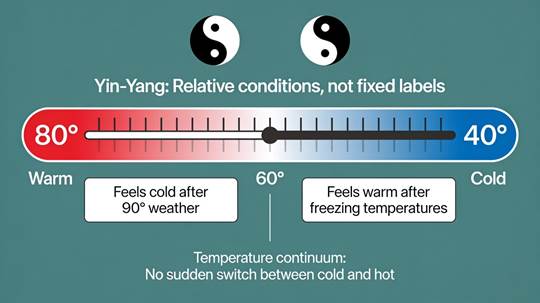
One of the easiest ways I have found to explain this is to think about a thermometer. We might say that 80 degrees is warm and 40 degrees is cold, but what about everything in between? There is no magical point where cold suddenly becomes hot. Temperature moves through degrees along a continuum. Even our perception of temperature depends upon what we are comparing it to. Sixty degrees may feel cold after several days of 90-degree weather, while the same 60 degrees may feel wonderfully warm after several weeks of freezing temperatures. Yin and yang can be understood in much the same way. They describe relative conditions rather than permanent labels.
This becomes clearer when we consider what I refer to in my teaching as the five manifestations or relationships of yin and yang: opposition, interdependence, mutual consuming and increasing, mutual transformation, and infinite divisibility. These concepts help move our understanding beyond the familiar black-and-white yin-yang symbol and into something we can actually observe throughout nature and our own lives.
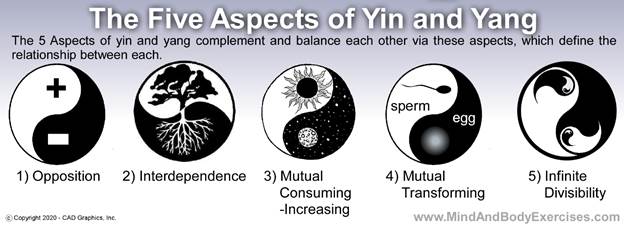
Opposition is probably the easiest manifestation to recognize. Day and night, activity and rest, heat and cold, expansion and contraction all demonstrate contrasting qualities. Yet opposition does not necessarily mean conflict. The two sides actually help us recognize and define one another. We understand darkness partly because we have experienced light, and we recognize stillness because we understand movement.
This leads naturally into interdependence. Yin and yang do not exist independently of one another. We cannot meaningfully describe something as hot without having some concept of cold. Movement is understood in relation to stillness, just as day has meaning partly because there is night. Each side provides a reference point for the other. This is one reason yin and yang should not be viewed as competing forces where one side must eventually defeat the other. Their relationship is complementary.
The manifestation I find especially useful when discussing the stages of our lives is mutual consuming and increasing. This describes how, as one aspect increases, the other relatively decreases. We can observe this simply by watching a day unfold. As morning progresses toward midday, the yang qualities of light, warmth and activity generally increase. As afternoon moves toward evening, these qualities begin to decline while the yin qualities of darkness, coolness and rest gradually increase.
There is no precise moment when day suddenly becomes night. Sunrise itself is a transition. Darkness gradually gives way to light. The sun rises higher, the air warms and activity increases. Later, the process reverses. The sun descends, shadows become longer, temperatures begin dropping and eventually darkness returns. Yang has gradually decreased while yin has increased. Then, during the night, the process eventually begins moving in the opposite direction again.
This is very similar to the thermometer. The temperature does not have to drop from 80 degrees to 60 degrees. It passes through 79, 78, 77 and all of the smaller measurements in between. Nature tends to move through transitions rather than constantly jumping between absolutes. Yin and yang provide a philosophical way of describing these changing relationships.
This also helps us understand why balance does not necessarily mean maintaining a perfect 50/50 relationship between yin and yang. Nature rarely seems interested in remaining perfectly balanced in that sense. Summer does not contain exactly the same amount of warmth and daylight as winter. Noon does not contain the same amount of light as midnight. The relationship is constantly adjusting. Balance, therefore, can be dynamic rather than static.
We can see this same process across the course of a human lifetime. The earlier stages of life tend to contain many yang characteristics. Children run, climb, jump, explore and seemingly move simply for the sake of moving. Young adults often continue this outward expansion as we build careers, raise families, compete, travel, accumulate experiences and test ourselves against the world. There is often considerable emphasis upon doing, achieving and moving outward into life.
As we grow older, the proportions may gradually change. This does not happen on a particular birthday, nor do we suddenly become “yin” because we have reached a certain age. Instead, the degrees begin shifting. We may become more selective about where we spend our physical and emotional energy. Physical training may gradually shift from concerns about how much weight we can lift, how fast we can run or how hard we can strike toward maintaining mobility, balance, coordination, breathing, posture and overall health.
Our priorities may change as well. Experiences can become more important than possessions. Understanding may become more valuable than proving ourselves correct. Listening can become as important as speaking, and reflection may begin accompanying action. This can be viewed as another example of mutual consuming and increasing. Some of the yang characteristics that dominated earlier stages of life may gradually decrease while certain yin characteristics increase.
Of course, this does not mean that older people are yin and younger people are yang. That would simply return us to the black-and-white thinking we are trying to move beyond. A 70-year-old lifting weights or hiking a mountain is expressing relatively yang qualities. That same person sitting quietly afterward, practicing breathing exercises or reflecting upon the day’s experiences is expressing relatively more yin qualities. Likewise, a young martial artist practicing a slow tai chi form may be expressing more yin qualities than an older practitioner performing vigorous strength training. Yin and yang always depend upon what we are comparing.
This is also where infinite divisibility becomes important. Even something we categorize as yang contains different degrees of yin and yang within itself. Exercise may generally be considered yang compared with sitting quietly, but walking is relatively yin compared with sprinting. Jogging might be more yang than walking but more yin than running at full speed. We can continue making these distinctions almost indefinitely. The same principle applies to yin. Sitting quietly may be yin compared with walking, while deep sleep may be even more yin compared with sitting awake. Every time we divide something into yin and yang, those divisions can themselves be divided again.
The principle of mutual transformation takes this relationship another step further. Under the appropriate circumstances, yin can transform into yang and yang into yin. Night eventually becomes day, just as day eventually becomes night. Vigorous activity eventually creates the need for rest, while sufficient rest restores our capacity for activity. Winter eventually gives way to spring, and the quiet dormant period of nature becomes the foundation for renewed growth.
I have noticed a similar transformation within martial arts and mind-body practices. When we are younger, we may be fascinated primarily by speed, strength, flexibility, techniques, forms, fighting applications and physical accomplishments. We want to learn more and do more. Over time, however, some practitioners begin asking different questions. Instead of simply asking how to perform a movement, we begin asking why we are performing it. Instead of constantly collecting another form, another technique or another exercise, we may spend considerably more time examining the principles contained within movements we already know.
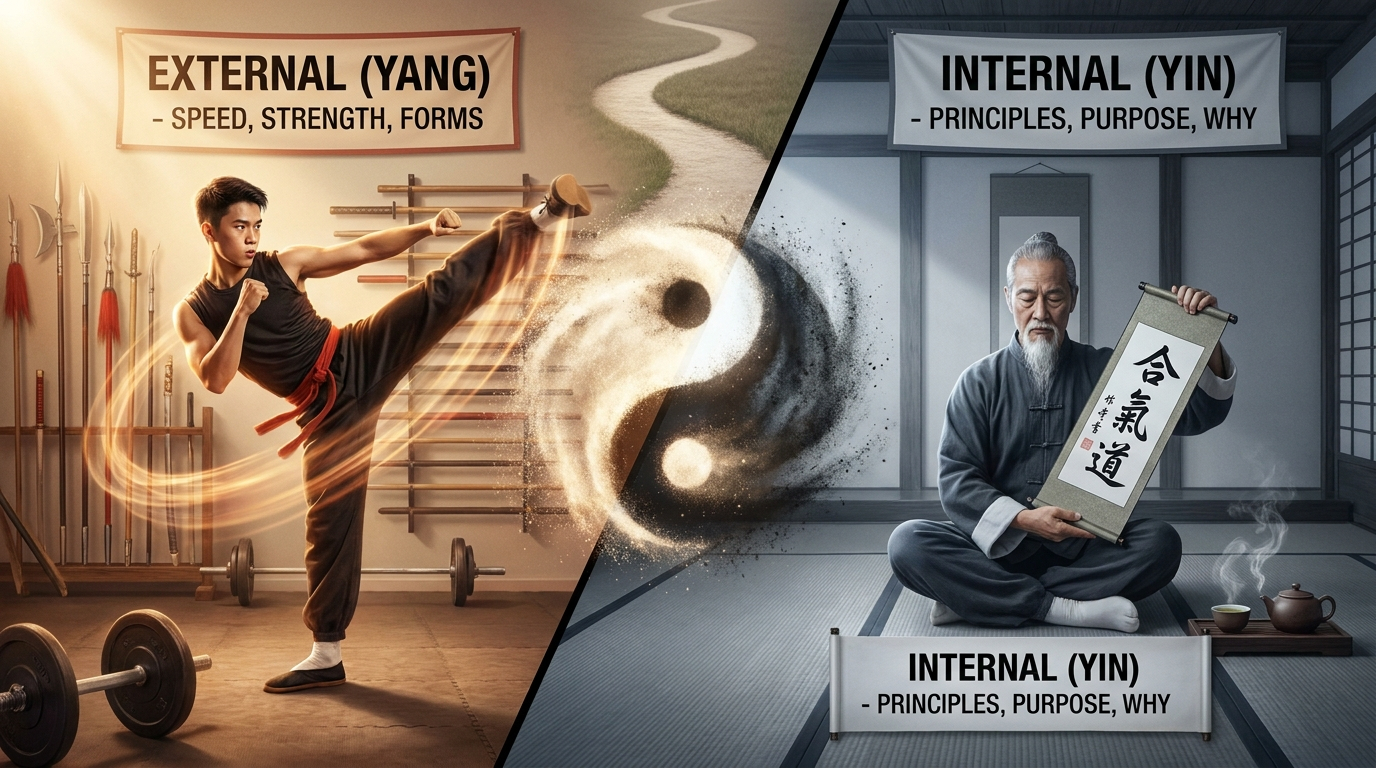
The external practice gradually creates an opportunity for internal observation. Tai chi, qigong, yoga, meditation and many traditional martial arts contain this possibility. At first we may be concerned primarily with what our body looks like from the outside. Where does the foot go? Where should the hand be? How low should the stance be? Eventually our attention may begin turning inward toward what the movement actually feels like, where we are holding unnecessary tension, how our breathing changes and whether we can sense our balance shifting before we lose it. The exercise may look almost identical from the outside, yet the experience occurring within the practitioner may be considerably different.
This brings us to an observation from the Swiss psychiatrist Carl Jung. In a 1916 letter, Jung wrote, “Who looks outside dreams; who looks inside awakes.” The statement appeared within a longer discussion about the importance of turning attention inward and examining oneself (Jung, 1973). I think this provides an interesting bridge between Western psychology and some of the ideas we encounter within yin-yang philosophy.
Much of our younger life is understandably directed outward. We wonder what we can accomplish, what we can obtain, where we can go and what we can become. We are concerned with establishing ourselves within families, careers and communities. These are not foolish or superficial concerns. They are important parts of interacting with the world and developing ourselves within it.

Over time, however, another set of questions may become increasingly important. Why do I believe what I believe? Why do certain situations bother me? Why have I repeatedly made some of the same choices? What have my experiences actually taught me? What should I continue carrying with me, and what should I finally let go? These are quieter and more inward-looking questions. In that sense, looking outward might be considered relatively more yang, while looking inward and reflecting upon ourselves might be considered relatively more yin.
Neither direction is necessarily superior. Too much outward activity without reflection can leave us constantly busy without understanding why we are doing what we are doing. Too much inward reflection without action can leave us contemplating life without actually living it. There are times to act and times to wait, times to speak and times to listen, times to push ourselves and times to recover. There are times to experience the world around us and times to consider what those experiences have taught us.
Even within a single day, we continually move through these degrees. We awaken from the relatively yin state of sleep and become increasingly yang as we get out of bed and begin moving. We work, exercise, interact with people and engage the outside world. Eventually activity begins to decline. Evening arrives, the lights dim, conversations quiet down and the body prepares for sleep. Yang gradually decreases as yin increases. Then morning comes and the cycle begins again.
Perhaps this is one of the most practical lessons contained within yin-yang philosophy. Life is rarely absolute. We like categories because they make the world easier to understand: hot or cold, strong or weak, active or passive, young or old, healthy or unhealthy. But much of human experience exists somewhere between these extremes.
The five manifestations of yin and yang help us understand why. Opposites define one another. They depend upon one another. As one increases, the other relatively decreases. Under the appropriate circumstances, one can transform into the other. And within every distinction we make, further degrees of yin and yang can still be discovered.
As we move through life, our own relationship between these qualities changes as well. What served us at 25 may not serve us in exactly the same way at 65. That does not necessarily mean that something has been lost. It may simply mean that our position along the continuum has changed. The outward journey can gradually become accompanied by a deeper inward journey. Movement becomes increasingly balanced by stillness, speaking by listening, doing by reflecting and accumulating experiences by trying to understand what those experiences actually mean.
Perhaps wisdom itself involves becoming increasingly comfortable with these changing degrees. Yin and yang remind us that we do not always have to choose one side and reject the other. Instead, we can learn to recognize where we are at a particular moment, what the circumstances require and when the balance may naturally begin moving in another direction.
Just as daylight gradually becomes darkness, summer eventually gives way to winter, activity leads toward rest and rest eventually prepares us for activity again, our lives continue to move through different degrees of yin and yang.
The degrees are always changing, and so are we.
Reference
Jung, C. G. (1973). Letters of C. G. Jung: Volume 1, 1906–1950 (G. Adler & A. Jaffé, Eds.; R. F. C. Hull, Trans.). Princeton University Press. (Original letter written October 22, 1916)



… reposted this!
LikeLike
… reposted this!
LikeLike
… reposted this!
LikeLike
… reposted this!
LikeLike
… reposted this!
LikeLike
… reposted this!
LikeLike
… reposted this!
LikeLike
… reposted this!
LikeLike
… reposted this!
LikeLike
… reposted this!
LikeLike
… reposted this!
LikeLike
… reposted this!
LikeLike
… reposted this!
LikeLike
… reposted this!
LikeLike
… reposted this!
LikeLike